
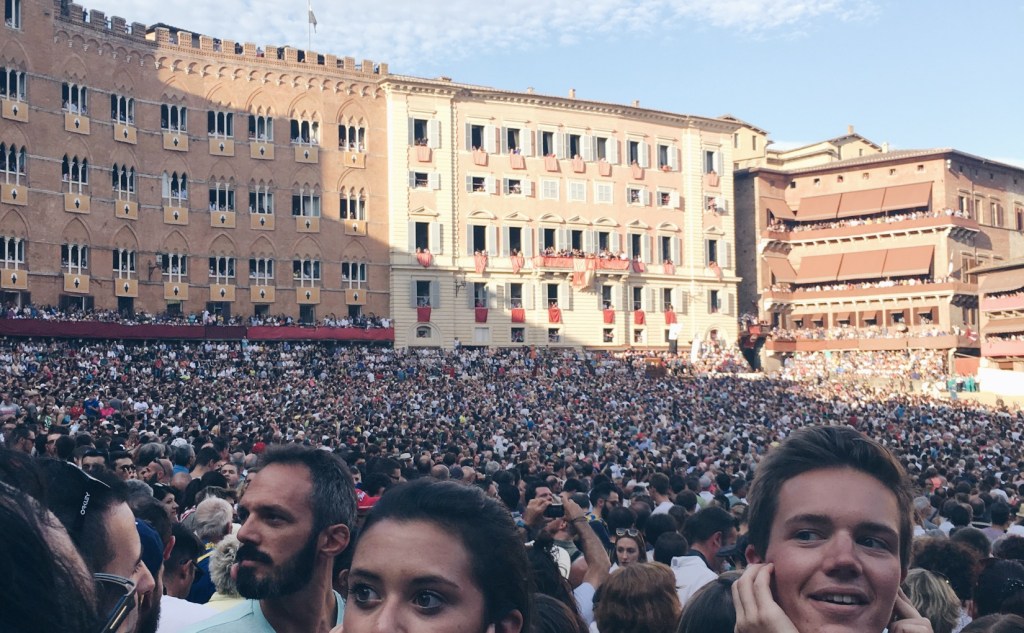
It is Palio Day here in Siena and it also marks 20 days here in Italy! Thus far, I feel as though I have watched the preparation that the city of Siena goes through for the Palio and it really does amaze me to have seen the transformation happen before my eyes. From the process of each contrada dinner happening in the evenings, to the set up of the dirt and bleachers in the Piazza, I was mesmerized to see it all happen the same way the locals do twice each year.
What was also phenomenal was the process of the tear down as well. Within minutes of the Palio finishing, I noticed that there were people already starting to pack away chairs from the bleachers. Pertaining to the actual leadership that is involved in each contrada, I came to fully understand it a few days after the actual Palio, when we had to opportunity to have a one-on-one with Francesco, who answered our questions about the contradas and the Palio thoroughly. For example, a big misconception that I’ve had is the idea that most of the work that is done (aka cooking for the contrada dinners, setting up chairs and tear down) was volunteer work. Although this may be true, the only difference is that during the Palio some of these volunteers are paid and external services are brought in to do the cooking and cleaning.
These tasks are always the concern of the Priore, who delegates the smaller tasks to others in charge below them. This reminds me of Hofsteade’s power distance, where I believe that Italy falls on the medium to low level when it comes to expectations around equal distribution of power. I’ve come to conclude that there is clearly an uneven distribution with power when it comes to Italian culture, be it with socio-economic status, gender, or even race. These are all claims that many cultures in our society today are susceptible to, and it is by no means an attack, but more so a keen observation of mine. With the socio-economic status within contradas, it is a given that the most wealthy have the most power when it comes to making decisions and obtaining positions of great responsibility and power within the contrada. As was confirmed to us by Francesco, the Priore and the Capitano must have lots of money to serve that position, and likewise, they are expected to contribute bigger amounts of money than most other contrada members. With regard to gender, Francesco also mentioned that although women are allowed to partake in the politics of the contrada, they rarely do. I have also seen smaller hints of this in my day to day life in Siena, as I have noticed that only men march in the parades. Race also seems to be an uneven distribution within Italian society as I’ve noticed that at the Palio and the local markets the one going around to sell flowers and little knick knacks are people of colour, who, most of the times, tend to be shunned away by annoyed tourists.
I think this is a phenomenal observation because I am curious to know what the other side of the story looks like on the Southern end of Italy. I guess once we get to Sicily I will find out. Keep you updated!
Staying Keen,
Lubna
 Lubna Alli
Leave a comment