
The radio of my beat up ‘04 Dodge Caravan hummed, drifting in and out of connection as it belted out what it could of Adele’s Hello. As it did so, I drifted back into focus, realizing my vision had become blurred and my thoughts encapsulated by something as trivial today as it probably was a few months ago. Whether it was the rain hitting the windshield or the series of tear droplets running down my cheeks, or even a combination of both, I couldn’t tell. How I had become a mess so quickly was beyond me. It seemed not too long ago I had some sort of direction and purpose. The same kind of drive, respect and zest I was once known for was now a foreign concept. Now, I felt sluggish and unmotivated, barely able to get myself out of bed, let alone find purpose in dusting on a little bit of powder to make myself look presentable.
It is because of this scene that I remember this time last year so clearly. For it serves as a reminder of how much strength it provides me with today. So vividly ingrained in my memory, it replays in my head at some of my lowest lows and highest highs, serving as a constant reminder of how proud I am of myself for managing to get out of that rut. My daily life was so trapped within the same simple routine that I had felt suffocated. I had wanted change, something that would help me reclaim myself. Back in high school, living within the bounds of the mundane routines of my daily life didn’t faze me the way I’ve realized it now does. I guess it’s the different when everybody packs up their things and moves on, and then you’re left feeling all empty inside, like you’re the one being left behind.
You see, not moving away after high school was something that was not entirely my choice. Yet, it was (and still is) something that I feel has had an immense impact on the person I am today. Growing up in a household where the only time it is really permissible to move out is upon marriage, I constantly felt a push and pull between Canadian culture and Guyanese culture. Be it in my personal life or my professional life, I find myself always at crossroads when it comes to what my morals and values are and how I should define them. Who am I really? Guyanese-Canadian or Canadian-Guyanese? Am I Guyanese before I am Canadian? Or am I Canadian before I am Guyanese? Or am I an equal mix of both? I’ve always felt lost when it comes to my sense of identity because of the constant struggle between what my family has socialized me to believe in and what I have been influenced to believe in through outside sources.
The radio buzzes, snapping me back into reality. I scan my surroundings, looking through the dripping window to see what else was happening in the world around me. I start to my right, skipping over the guy in the driver’s seat of the black Honda Civic next to me, and work my way around to the left, landing on a busy Metro parking lot. I see lots of frazzled moms trying to do double duty, rushing to drop their grocery bags into their car trunks, all the while rallying their screaming kids, who insisted on playing in the pouring rain. These same mischievous kids reminded me of myself growing up. Growing up, mischievous was probably the word most frequently associated with my name.
I lived the first seven years of my life in a small village in Guyana known as Enmore. My house was off the main road, through a path that wasn’t cemented and that was ridden with bumps and potholes that had formed overtime once the dirt mixed with the rain. Our small community of houses were sandwiched by a sugar estate on one side and a cow pasture on the other. My three sisters and I grew up knowing all of our neighbours, and them knowing us. Me, in particular, I was known as the loud, troublemaker of the bunch. I was outspoken, bold, and quick witted, something the snow cone man that passed around everyday at 1pm counted on to make a sale. Each day as 1pm grew near, I would prepare my pitch to my mom as to why I was deserving of some money to buy a snow cone. I was creative with my reasoning, offering up my time to help with the dishes or to run to the market to buy whatever ingredients she needed that day to cook. At times, my sisters were crazy enough to fall for my convincing and they readily joined in on my extravagant plans. I was their older sister, and they looked up to me as an example of what they could and could not do.
I remember one day vividly, as my mom always draws upon it as a perfect example when she’s looking for a good laugh. A few nights prior, we had slept over at my grandmother’s house just a few blocks up the street. While there we watched television, something we didn’t have the luxury of having at our home. I distinctly remember glimpsing at the TV and seeing a birthing scene from The Young and the Restless, a soap opera that is somewhat of a household name in the West Indies. After seeing this, it became my genius idea to play doctor with my sisters. So, our playtime consisted of running to Helen’s shop up the road to buy chewy candy that was to act like prescription pills. I delegated tasks, making sure that each person was given a job they could complete. One sister was to help with the building, another to gather the supplies, and another to stockpile snacks in the event that we got tired. We set up shop on the front veranda, using broomsticks and cushions from the couch, and pulling bed sheets that were drying on the clothesline to build a fort and a hospital bed. The teddy bear that our other grandma from Canada (who we had fittingly dubbed with the name Canada-gramma) had brought for us when she came to visit earlier that year served as our pretend baby. “Okay, we can almost see the head. Push just a little harder, you’ve got this,” I said, reassuring my little sister (who had volunteered to be the pregnant one) that she would be able to make it through the delivery. Man, was I something. I was a creative. I was all for concepts, theories and innovation.
I was not the norm of the ideal child in a Guyanese household, where you were expected to be an academic. In some ways, I am convinced to believe that I am an idea oriented person because of my surroundings growing up, where like most kids, I did not have television or video games. Fun for me was spending the evening building kites with my dad and then taking them to the pasture to fly, or climbing the mango and coconut trees in my backyard and then devouring the fresh fruit, as the sweet juices ran down my cheeks, making my face and fingers sticky as it dried with the cool breeze. Or, on days when we went into the city, we bought Hack’s Halal, parked the car in the botanical gardens and picked lily pads from the river to use as our plates. And at nights, fun was in its simplest form. We would sit outside on our veranda in the quiet night and stargaze, creating our own stories about what the various collection of twinkling dots in the sky meant, talking about what we were thankful for, and praying that we would one day be able to come to the promised land of opportunity known as Canada.
I live in my head a lot, and often times, even today in my professional life, I find that I am caught up in the same dilemmas that the idea oriented leader tends to fall into. I am overly passionate. And, sometimes, because of this over passion, I find myself loosing sight of the game plan necessary for putting my extraordinary ideas into fruition. Now that I’ve managed to identify this as my weakness, I am now able to look out for this as something that I can work on to improve my ability to work in a team dynamic in the future. Regardless of this fact, I attribute a lot of my creative drive to a childhood of not having Barbies and PlayStations, but instead, treating my surroundings as my playground. I come from humble beginnings. My family does not have much, and the things that others may take for granted are very special to me. To come to Italy alone was a big deal. Other than flying to Canada from Guyana, flying to Italy was my first time on an airplane. While others knew how to navigate their way through an airport, I was not familiar with the process at all. And, while everyone had their families at the gates to bid them farewell I was just dropped off and left to figure out most of the process on my own.
As simple and carefree as the life in Guyana was, there was still stress and concern for safety. I’ve seen the rough side, sometimes more than I’d like to remember. Growing up in Guyana during a time when crime was at it’s worse and when political tension was on a rise, I’ve lived through shootings, seen vandalism amongst neighbours, and been next in line to have car tires set on fire. And, through it all, I’ve managed to embrace these ups and downs as I define who I am and what makes me valuable in society. I’m tough and put up a mean front, and I think it is for this reason that, under Hofsteade’s 5 Cultural Dimensions, I am an individualist and not a collectivist. I am so used to having to do things on my own that I’ve become numb to the idea of depending on anyone. I have a hard time letting go of the reins and giving up the power. I am used to fending for myself and, sometimes, when others make nice gestures, instead of taking it at face value, I wonder what it is they may want from me.
I think its quite interesting that I consider myself more of an individualist rather than a collectivist. I believe that this is a pretty good indication of the impact that both Canadian and Guyanese culture has had on my leadership style. Unlike Guyanese culture, where the society is highly collectivistic and places a high importance on family and doing things together, I believe that after moving to Canada and having lived here for more than half of my life, I have been influenced by society and culture here. The reason I most likely identify as an individualist is because I have been schooled in a system where there are others who value freedom, self-expression and, personal rights. As well, in individualistic societies, getting a task completed is more important than relationships, something that I can attest to as being characteristic to who I am when it comes to my professional (and sometimes personal) life.
Referring to the Geert-Hofstede model, there are no statistics on Guyana, leaving me to use the stats of nearby countries such as Venezuela, Suriname, Brazil and Trinidad and Tobago as points of reference. I compared Italy and Canada with these countries to see how they measured up against “Guyana’s results.” Much to my surprise, Italy did not produce results that were as similar to those of Guyana’s. From what I had gathered, Guyana has a significantly lower long-term orientation and a significantly higher indulgence compared to Italy. The reason I am surprised is because while in Italy, I found a lot of cultural similarities between Guyana and Italy so I had automatically categorized them together. What I failed to realize was that Italy is far more developed and advanced, economically speaking, compared to Guyana. This was a significant point for me because it helped me to realize why I sometimes struggle with integrating with certain aspects of Canadian culture. A prime example that I struggled with a lot throughout high school and, more specifically, when I was Student Council President, was tardiness. Much like Italians, Guyanese have a hard time adhering to schedules. A lot of the times, even when I did make an active effort to wake up early so that I could be on time, I found that my dad would end up making me late. I came to realize that because I was raised in a Guyanese household, I was still struggling with conflicting cultural differences when it came to trying to integrate into Canadian society. This brings another relevant example to the forefront. As a child, if it was raining outside or there was any remote reason that my sisters and I could stay away from school, my mom would let it slide and we’d have a day off spent watching cartoons in our pyjamas until 3pm. Now that I am familiar with Hofsteade’s model, I am now able to make this connection. At the time, as a child, skipping school seemed fun, but now as an adult in Canadian society, where such a high preference is placed on the results you produce, I find it hard to pull myself together when there are loads of different indulgences taunting me.
Likewise, one more thing about Guyana that is a stark contrast to Canada is the idea of a high-context culture and a low context-culture. In Guyana, much like in Italy, there is a high-context culture, where the preferred communication style is indirect, where politeness and ambiguity is commonly used. A stark contrast to this is the Canadian low-context culture, where the preferred communication style is through the use of directness, confrontation and clarity. This point from my notes really stuck out to me because it is something that I am conscious and aware of that I still struggle with in a professional setting. A recent example that comes to mind was having to deal with conflict in the workplace. As the Student Council President, members of my council looked to me to solve problems when there was tension between different members in the council. Of course, much to my dismay, this made my job a lot harder because when ended up happening most of the time was the problems would get swept under the rug and were never actually dealt with.
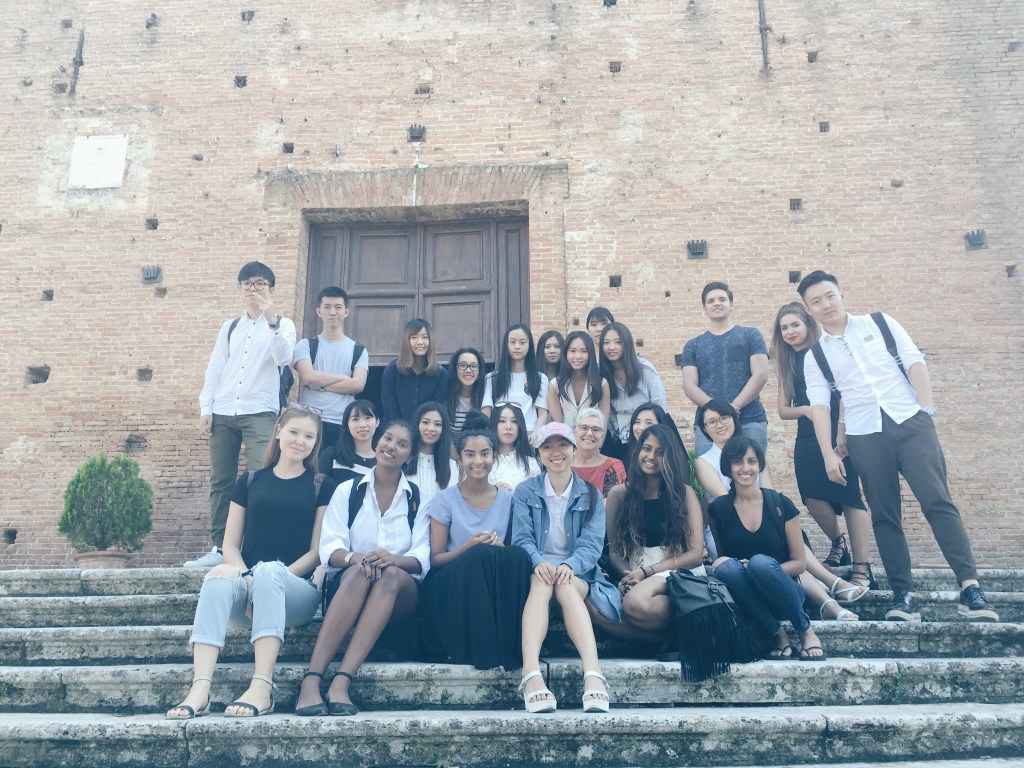
Taking this course through the University of Toronto’s Summer Abroad Program [IRE332: Cross Cultural Perspectives on Leadership] has led me to reflect a lot on what really makes a good leader. Prior, I had always felt that once the title of leader was slapped on you, then you automatically were a good one. I think that was the case for most of my life. Throughout my childhood, I was dubbed “a lil’ leader” by most of my family. Growing up, especially in high school, the theme stuck with my peers, always having volunteered me to run for student council or even in simple things like being the one to ask the teacher a question they were too scared to. Now, after having studied the topic of leadership, and more specifically, of how culture influences leadership, one phrase resonates with me. Francesco, the Vice-President of the Università degli Studi di Siena and a great leader in his own regard, defined a leadership as the following: “the role of the leader is to influence followers to achieve a shared goal.” I am starting to realize that maybe that is my purpose. My calling in life, be it in whatever form, is to serve as a positive stepping stool that can aid others in achieving a common goal.
The light changes from red to green, prompting me to bolt ahead. I strengthen my grip onto the steering wheel; I am ready for what’s to come.
 Lubna Alli
Leave a comment