
The Matter at Hand
Upon typing in the words “Malvern, Scarborough” into Google, the top related searches that Google spits out are “Malvern crime,” “Malvern ghetto,” “Malvern shooting” and “is Malvern a good place to live.” If this isn’t a tell-tale sign of the reputation that the community of Malvern in Scarborough’s East End holds, then I don’t know what is. This case study explores the issues concerning the reputation of being a ghetto that the community of Malvern faces due to lack of care for their advancement as a community. This lack of care is a cycle that has founded itself repeating history year after year, leading me to believe that this is a problem that could be fixed with the implementation of more funding and community development strategies. Ultimately, these concerns can only be talked about so much amongst the community members before it can be taken to higher levels of power within the City of Toronto, where the appropriate committees can discuss the issues and take action to improve the situation for committee members. This is where the problem lies, and therefore, how the problem finds a way to resurface year after year, hence, associating the label of “ghetto” with Malvern. In order to work towards stripping Malvern away from this label, it is important that the City of Toronto sees the comparatively lesser conditions that constituents living in Malvern face compared to those from other parts of Toronto. These comparisons will be analyzed in this paper in many facets, for example academic performance, transportation dependency, and housing. This issue is an important one that I have chosen to analyze as I grew up and lived in Malvern for 5+ years and know a number of many others who have seen much worse times in Malvern than I have. Having seen these effects of poverty in Malvern first hand, it is an issue that is near and dear to my heart and I truly believe it deserves more attention and care. The case study of Malvern, which is comparable to a Regent Park or a Rexdale or a Jane and Finch, relates to the themes of social mixing, transportation dependency and public housing as it concerns the theme of development and planning in this course. They will be further discussed in the forthcoming sections.
Malvern: The Backstory
This section reviews the background concerning the issue of Malvern itself as a ghetto. It will provide information that answers the questions of what, who, when, why, where, and how in regards to this case. In efforts to describe the examples of the issue, it is important to first look at the definition of the word ghetto. A ghetto, by definition, is “a part of the city in which members of a particular group or race usually live in poor conditions; the poorest part of a city.” (Merriam-Webster 2016) This will be the working definition used of the word ghetto in this paper.
Right off the bat, there are three main characteristics from this definition that are evident: racial segregation/ ethnic enclaves, poverty concentration, and underdevelopment. These points are, in fact, true and applicable to the community of Malvern. Alternatively, from a development and planning perspective, the implementation of strategies such as social mixing, affordable housing, and better representation are great examples of methods that can be used to fight the issues that give Malvern the label of ghetto.
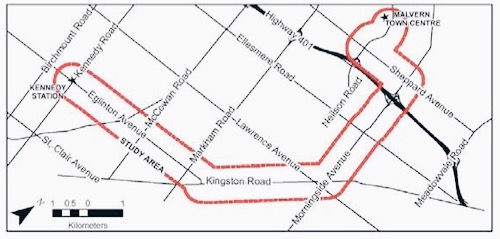
The community of Malvern, with a population of about 44,000, is located within the borders north of highway 401 to Steeles, and between Markham Rd. and Morningside Ave. It is located in the north-east end of the city of Toronto, more specifically Scarborough. Malvern is known to have the highest concentration of young people in all of Canada. (2013) Additionally, according to the same source, Malvern also has a significantly higher concentration of immigrants compared to other parts of Canada, where New Canadians constitute 61 percent of its population, making it highly culturally diverse. (2013) Upon the establishing of the Malvern Post Office in 1856 in David Brown’s general store, Malvern as a community came to be. Although Senator at the time David Reesor’s plan to dub Malvern the forthcoming ‘Capital of Scarborough’ via the extension of the Grand Trunk Railway failed, in the late 1950’s the Canada Mortgage and Housing Corporation attempted to change this. They did this by seizing the farmland and implementing a building plan to create a model community of affordable homes, where the first set of residents moved into their homes in 1972. (Dunkelman, 1997) As a result, a number of lower income families opted to buy homes in areas such as Scarborough, which was considered suburban land and provided a more budget friendly option for growing families who could not afford to live in more expensive areas of Toronto such as Old Toronto or York. Soon thereafter, an influx of immigrants started to find their way into Toronto, and naturally, with very little assets, they were forced to commit to affordable housing options such as the ones available in Malvern. Specific to the neighbourhood of Malvern, 43% (the majority) immigrated to Canada before 2001, which is 10% higher when compared to the City of Toronto. Additionally, the top-5 birth countries for all immigrants in Malvern are Sri Lanka, Philippines, India, Jamaica and Guyana. All statistics considered, the visible minority, as a percentage of the population in Malvern is an astounding 87%, compared to 49% as the overall City of Toronto rate. (City of Toronto, 2011) That is almost double! Additionally, the influx of a number of Sri Lankans as recent immigrants between the periods of 2006-2011 in Malvern is highly due to their escaping of persecution in their home country at a time where the Sri Lankan civil war was rampant. As is evident, this data has already begun to support the onset of what constitutes a ghetto. There are ethnic enclaves. There is a poorer population. And, as will be further explained, there is lack of care, which will be analyzed further in the next section.
Dissecting the Issue
In this section the case study of the community of Malvern as it concerns having the characteristics of a ghetto will be discussed and analyzed in hopes of coming to some consensus about the matter and a proposed solution to the problem. For starters, this case is relevant for the mere fact that Malvern is an underprivileged community that faces levels of poverty similar to other “rough” areas in Toronto like Regent Park, Jane and Finch and Rexdale, yet it receives comparatively less attention than the rest. When researching on this topic, there were very limited studies that came up specifically geared to the community of Malvern alone, although it was mentioned as a relevant example in a fair amount of scholarly journals that focused on rough communities. Fong and Shibuya’s research, which was done through analyzing census data from 1986 and 1991, (as cited in Walks & Bourne, 2006) suggests that there is a correlation between a higher density visible minority population and poverty within a neighbourhood. Additionally, also using the 1991 census data for Census Metropolitan Areas (CMAs), the results indicate, “Aboriginals and recent immigrants from Africa, Asia, Latin America and the Caribbean in particular are increasingly likely to live in ‘ghetto’ or ‘underclass’ neighbourhoods.” As is evident, this information reinforces the notion that ethnic enclaves are
With the issue of ghettos in Canadian cities, the most common point that is brought forth is that our ghettos, although seemingly dire to us, are nowhere nearly as problematic as those of other US cities, such as Baltimore, Detroit and Oakland. This is a point that gives a different perspective on the matter, and it is important because it reminds us about how relative of a scale we live on. Our perception of what is considered good or bad is highly affected by what we’ve already established as our grounds of comparison. To provide perspective, according to an article by Tracy Huffman featured in the Toronto Star, although the community of Malvern has areas with pockets of crime, it is not considered a ghetto. (2006) Huffman further goes on to explain that the gang violence in Malvern, specifically between the Malvern Crew and the Galloway Boys over a turf war, has helped to perpetuate the idea of Malvern as a crime ridden, unsafe place to be. Gang violence reinforces the concept of easy access to drugs and guns and is also impressionable on youth, who may be easily swayed to join a gang at a young age. According to the minutes put together from a public meeting held on November 17, 2005, Malvern’s youth are producing academic results that are significantly lower than the expectations. Additionally, in the school system, there are high levels of suspensions and expulsions, caused by violent and/or aggressive behaviour facing peers and teachers. (Toronto Police Services Board, 2005)
As a result of the gang involvement among youth, urban planners made the conscious decision to look at implementing more community programs geared towards distracting the youth of Malvern from the circumstances of a ghetto. In addition to this, the government made efforts to allocate more funding for these communities, by setting aside money in the budget for projects such as HOODLINC, where the objective is to “improve the life outcomes for multi-barriered youth living in Toronto Community Housing (TCH) communities in the Malvern community through providing youth with recreational and social development opportunities.” (Toronto Police Services Board, 2005) This initiative, along with others implemented in Malvern such as The R.O.S.E. Program (Real Opportunities for Success in Education) and the Malvern Community Coalition, are all in conscious efforts to provide the community with mentorship, employment assistance, and fitness and nutrition programs, amongst other services and programs. These solutions are typically what are brought to the table when developers are trying to figure out ways to improve and benefit the community as a whole.
These services and programs require approval and, this is where the glitz and glamour of a seemingly easy solution loses its sparkle, and where the reality of lack of care comes into play. The harsh truth is that we live in a capitalist, neoliberalism driven society where the rich pursue their interests to continue getting richer and the poor, unfortunately suffer the consequences and remain poorer. This is exactly the problem with the community of Malvern. David Miller, mayor of Toronto during a time when crime and poverty in Malvern was at its peak, managed to contribute to the problem, even in attempts to avoid neoliberal tendencies. According to Albo, “Miller’s administration continued to celebrate the ‘creative class’, criminalize homelessness, and increase the police budget, even though [it meant] reducing services to “socially deprived and racialized” communities such as Jane and Finch, and Malvern (as cited in Capurri, 2013). This being said, marginalized communities are forced to deal with the circumstances that are thrown their way because more times than not, they do not have the means to voice their issues and make their concerns known. Communities like Malvern, for example, have a very high population of single mothers. These single mothers are most likely working many jobs in order to support their family. Not considering, a majority are also dependent on public transportation. As well, in a community where significantly high amounts of the population are immigrants, the chances that there might be a language barrier are very high. All of these factors considered, the odds of someone who lives in Malvern making the effort to commute to a City Hall meeting in downtown Toronto to voice their concerns are not high. This continues to become a cycle that contributes to the problem, as those who are in a position of power to make a change tend to overlook the importance of an issue that is not brought to the forefront. Unfortunately for communities like Malvern, the only time that attention and care is placed on them are when it’s almost too late, and where the situation has escalated to a point where help is needed, and even then the government is stingy with what help they chose to offer. Boudreau et al., goes on to prove this point, claiming that “during the Miller years, right-leaning councillors (Case Ootes, Karen Stintz, Rob Ford and Denzil Minnon Wong just to name a few) advocated for the protection of taxpayers’ money and warned homeowners that their taxes were used irresponsibly to pay for welfare, treatment of drug addicts, and immigrants.” (as cited in Capurri, 2013). This reluctant, almost pitiful help is how many of the community initiatives were implemented in Malvern. The Malvern Community Recreation Centre, for example, was built with that intention, where the library serves as a safe home for many children who are forced to stay there while their parents are at work. The positive effects of these implementations are showing too, where “Youth usage of the Malvern Library has increased by 70% a a result of youth focused programming and targeted outreach.” (Toronto Police Services Board, 2005)
Moving Forward
As the situation in Malvern continued to progress and get worse, community involvement became more frequent, instead of being afraid to speak out in fear of retaliation from gangs. According to Huffman, there has been “a huge co-operation from a community [Malvern] that is fed up with the violence and the stigmas associated with the neighbourhood.” (2006) Furthermore, the conversation about Malvern continues to progress with increased community involvement, a strategy that seems to be making positive changes in the community, as it is no longer on the list of priority neighbourhoods in Toronto today. This, of course, does not dismiss the fact that the neighbourhood, though it has made progress, is still one that needs a lot more work to bring it up to par, or more optimistically, to a competitive level with other neighbourhoods in Toronto. The City’s implementation of programs and community development infrastructure were excellent attempts at aiming to overcome the poverty and ethnic segregation that the community fell victim to. Additionally, development strategies that consider more affordable/ public housing and that aim to work on social mixing help to fast track the process of lifting the reputation of ghetto that Malvern has.
Works Cited
Canada. Toronto Police Services Board. City of Toronto. Minutes of the Public Meeting of the Toronto Police Services Board. Toronto Police Services Board, 17 Nov. 2005. Web. 24 Nov. 2016. <http://www.tpsb.ca/component/jdownloads/send/18-2005/296-05nov17pmm-pdf>.
Capurri, V. (2013). ‘Residents’ or ‘taxpayers’? neoliberalism, rob ford’s mayoral campaign, and the meaning of urban citizenship. Canadian Journal of Urban Research, 22(2), 1-17. Retrieved from http://myaccess.library.utoronto.ca/login?url=http://search.proquest.com/docview/1675910669?accountid=14771
Dunkelman, D., DD. (1997). Toronto Neighbourhood Guide. Retrieved November 22, 2016, from http://www.torontoneighbourhoods.net/neighbourhoods/scarborough/malvern/history
“Ghetto.” Merriam-Webster.com. Merriam-Webster, n.d. Web. 22 Nov. 2016.
Huffman, T. (2006, Mar 21). Violence on upswing in malvern; police taking preventative action, keeping an eye on area gunfire down from 2004, which saw a record 22 shootings. Toronto Star Retrieved from http://myaccess.library.utoronto.ca/login?url=http://search.proquest.com/docview/438951738?accountid=14771
“Malvern – Social Profile #4 – NHS Languages, Immigration, Income (PDF).” Demographics – Your City | City of Toronto. City of Toronto, 2011. Web. 22 Nov. 2016. <http://www1.toronto.ca/wps/portal/contentonly?vgnextoid=b654edb4bcae1410VgnVCM10000071d60f89RCRD&vgnextchannel=1e68f40f9aae0410VgnVCM10000071d60f89RCRD>.
Training initiative reaches out to Malvern community. (2013). Retrieved November 22, 2016, from http://www.canoe.ca/CareerConnectionNews/050720_youthforce.html
Walks, R. A., & Bourne, L. S. (2006). Ghettos in canada’s cities? racial segregation, ethnic enclaves and poverty concentration in canadian urban areas. Canadian Geographer, 50(3), 273-297. Retrieved from http://myaccess.library.utoronto.ca/login?url=http://search.proquest.com/docview/228371823?accountid=14771
 Lubna Alli
Leave a comment