

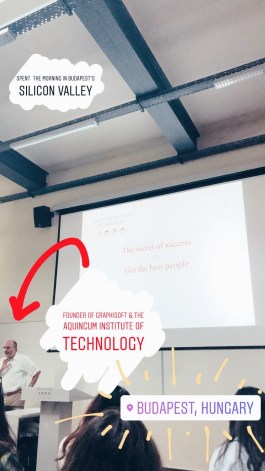
 Completing our third week of RSM395, our class made our way to Budapest, Hungary to meet with Graphisoft’s former founder and CEO Gabor Bojar, who provided a thorough, informative and engaging presentation about his journey into the entrepreneurial and tech world. The main driver of his presentation was that the key to success is great people. This, paired with the presentation at the very end given by Gabrielle was a little off-putting as it turned the Graphisoft visit into more of a sales pitch rather than a helpful account of what it means to run a successful business. As a humanities student, my brain has been trained to nitpick and think critically at any chance I get and so, at times, I have to remind myself to take a step back and give others the benefit of the doubt. The first thing I did before gathering my thoughts and reviewing the notes I had taken during the presentations was Google search Bojar to see if I could find any dirt on him to support my nitpicking. I was mainly looking to scrutinize his educational and

familial background since the main point he boasted about was that it requires good people to run a successful business. Right off the bat, as someone that was born and raised in the so-called hood, his statement came off as fluffy to me seeing that the people I was raised within the same socio-economic demographic rarely trust others and often find loopholes and way to cheat the system to get their come up. Many of them don’t have the education, finances (and other) support, means or connections to get into the technological or entrepreneurial sphere. As such, my critique of Gabor’s statement is directed first at his white privilege, whether he is aware of it or not.
White privilege, which is not as renowned a concept today as it was, say, 25 years ago is the societal privilege that benefits people whom society identifies as white in some

countries, beyond what is commonly experienced by non-white people under the same social, political, or economic circumstances. According to Peggy McIntosh, whites in Western societies enjoy advantages that non-whites do not experience, as “an invisible package of unearned assets”. White privilege denotes both obvious and less obvious passive advantages that white people may not recognize they have, which distinguishes it from overt bias or prejudice. These include cultural affirmations of one’s own worth; presumed greater social status; and freedom to move, buy, work, play, and speak freely. The effects can be seen in professional, educational, and personal contexts. The concept of white privilege also implies the right to assume the universality of one’s own experiences, marking others as different or exceptional while perceiving oneself as normal.
In addition to the fact that Bojar is white, we must also look critically at the fact that Bojar is also male. This is not new rhetoric that the old white men are the ones running successful businesses and dominating the market when it comes to profit. If we look back in hindsight at all of the presentations of the businesses that we have attended, the one common factor is that they are all old rich white men. With the exception of UNIDO and OPEC, which don’t fit the description of white, they embody privilege in other ways related to hierarchy and family money.

On the contrary, although the presentation by the Institute for Foreign Affairs and Trade (KKI) was presented by two white men, the information they provided focused more on more humanistic qualities, where some of the main topics that they look at were the governance of the external economy in Hungary, the FDI outlook, the investment promotion agencies, and V4 as an investment location. What is particularly noteworthy is that the work that they do is a project-based approach that is measured by the number of projects, job creation, investment value, and changing the environment. With regards to destination countries creating the highest number of new jobs, India, US, Mexico, China and Thailand are the front-runners. What is interesting is that there is almost a parallel with our history of colonization and economic development today. The information provided by KKI indicated that most western countries are looking to invest in African, Asian and Latin American countries. The common trend of outsourcing and class difference is very much still alive. We must look

at these statistics critically because, despite the fact that the statistics boast lots of jobs, these jobs are still menial and not necessarily ones that provide competitive wages, benefits, and job security. This can be supported by the FDI Ranking provided in the presentation which listed the average job value of projects are Ireland, Denmark, Singapore, Netherlands, and Hungary in that order. The value of the jobs and the actual number of jobs are two very different stories, and it is evident and the jobs with the most value still come from the countries with the most Eurocentric values.
This is critique was not to undermine the hard working and dedicated people that are required to run a successful operation. There is no denying that it takes hard work and grit to produce exceptional results in all that you do. But, what we must not forget is the head start that those who are born and raised more privileged than others have.
 Lubna Alli
Leave a comment