

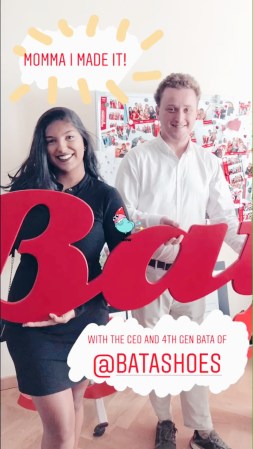
 As the course comes to an end, it seems as though all of the course concepts are coming full circle. Particularly noteworthy is the introduction of the Bata Shoe Company’s original headquarters in Zlín in the first week and now in the final week in one of the current headquarters in Prague where the focus is on the strategies that the company uses to keep their brand relevant. As mentioned in the presentation, the first mission was to give shoes to humanity and now the mission is to give back humanity to shoes. This shows the impact and heritage that Bata has had on many homes worldwide. It was mentioned how in many countries the word Bata is also synonymous with the word shoe. As a company, they are able to have as they evolve.
What is interesting and humbling was despite the fact that he came from a lot of money, the 4th Generation Bata of Bata Shoe Co. Thomas Archer Bata, and also the Chief Marketing Officer (CMO) was personable and did not have an air of haughtiness about him. I point this put specifically as a postlude to last
 week’s journal where I critiqued the old white male dominance in the entrepreneurial sphere. Perhaps Bata’s humanistic qualities are also attributed to his youth as he was born in 1988 and so he was easier to connect to on a conversational level. We must also not forget that his great great grandfather was a man know for founding his business on these same principles. Thomas Archer also mentioned that he has a degree in Political Science and Economics rather than Business, lived in Canada for a few years (hence why his English was stellar) and, that he also worked for the competitor Nike before coming to Bata. It seems that because his path wasn’t as cookie cutter as it should be expected to be is the reason why he was personable. His journey shows that he tried to separate himself from the Bata label in the early years of his career and that after he was content with his own self-discovery he decided joined the family business. Choice is not a luxury that many are lucky to have, and this luxury of choice that Thomas Archer had is what contributed to the wider lens of view he can leverage from a business standpoint.
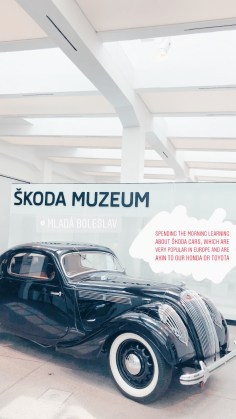
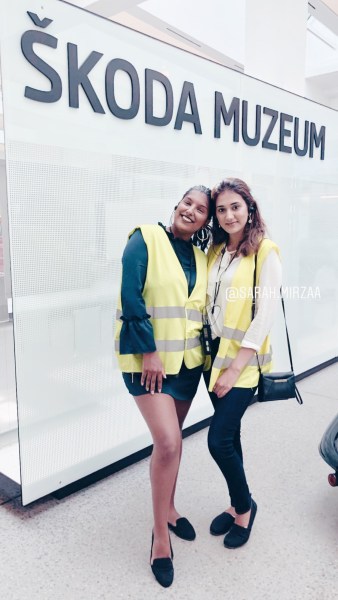
What was also particularly enjoyable from this weekend was the Škoda tour of their manufacturing plant as I felt like I was able to draw a lot of insight into their business model and employee culture from an Operations standpoint. Coming from the Operations department at Scotiabank, and being on the front end at that, I was very
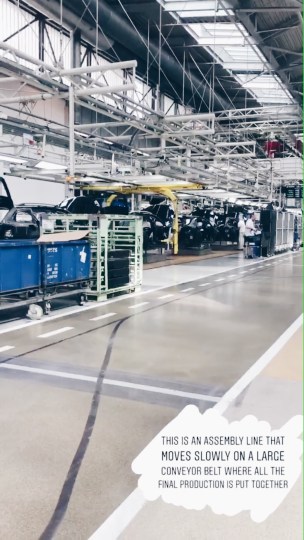
curious to see how Škoda manages to offer a healthy work-life balance to its employees. It is both fortunate and unfortunate that I see so many similarities in the ways in which both Škoda and Scotiabank meet their operational needs at the cost of the employee. The first thing that stuck out to me was the firm time restraints that are put on each of the teams to complete their allocated tasks. There is 59 seconds for each team to complete their tasks per car on the conveyor belt, each employee is granted only one 30-minute break and two 5-minute breaks, and the whole line taking 2 hours and 30 minutes. It was also mentioned that there are punishments for those who could not comply with company expectations. Additionally, despite the fact that there is a canteen where employees can buy a filling lunch for less than 2 Euros, it was mentioned that the walk to the canteen is so far that many employees opt to pack their own lunches so to maximize on their lunchtime. Of particular relevance is the short break times compared to the legal Canadian amount of one 30-minute lunch and two 15-minute breaks per 8-hour shift. Even on top of this, in the Operations department at Scotiabank, we were also allocated an additional 15 minutes each day for a team huddle. There were also bi-weekly 1-hour coaching sessions, monthly town hall meetings and appreciation lunches for top performers that usually added to the overall wellbeing of the atmosphere. On a day where all of these things were scheduled, you were only actually working about 5-6 hours out of an 8-hour shift. Despite the fact that these were not incentives that were mentioned during to tour or the Q&A section, it is also important to consider that Škoda employees are unionized, unlike Scotiabank employees.
Perhaps there is a trade-off of some sort that is involved and the benefits that one provides, that the other cannot. During my last few months with the company, it seemed as though most of my co-workers would vouch for unionization as more valuable seeing as job security became a point of contention with regards to outsourcing and cutting costs to meet operational needs pushed by the higher-ups. Likewise, I am confident that the same targets and time changes were brought forward by higher-ups who were looking at ways to maximize utility and increase efficiency.
From an operational standpoint, The Bata Shoe Company, Škoda and Scotiabank all approach their managerial components in a different style which allows room for them to draw on different feedbacks and styles to step up or dial back the level of enforceability.
 Lubna Alli
Leave a comment