
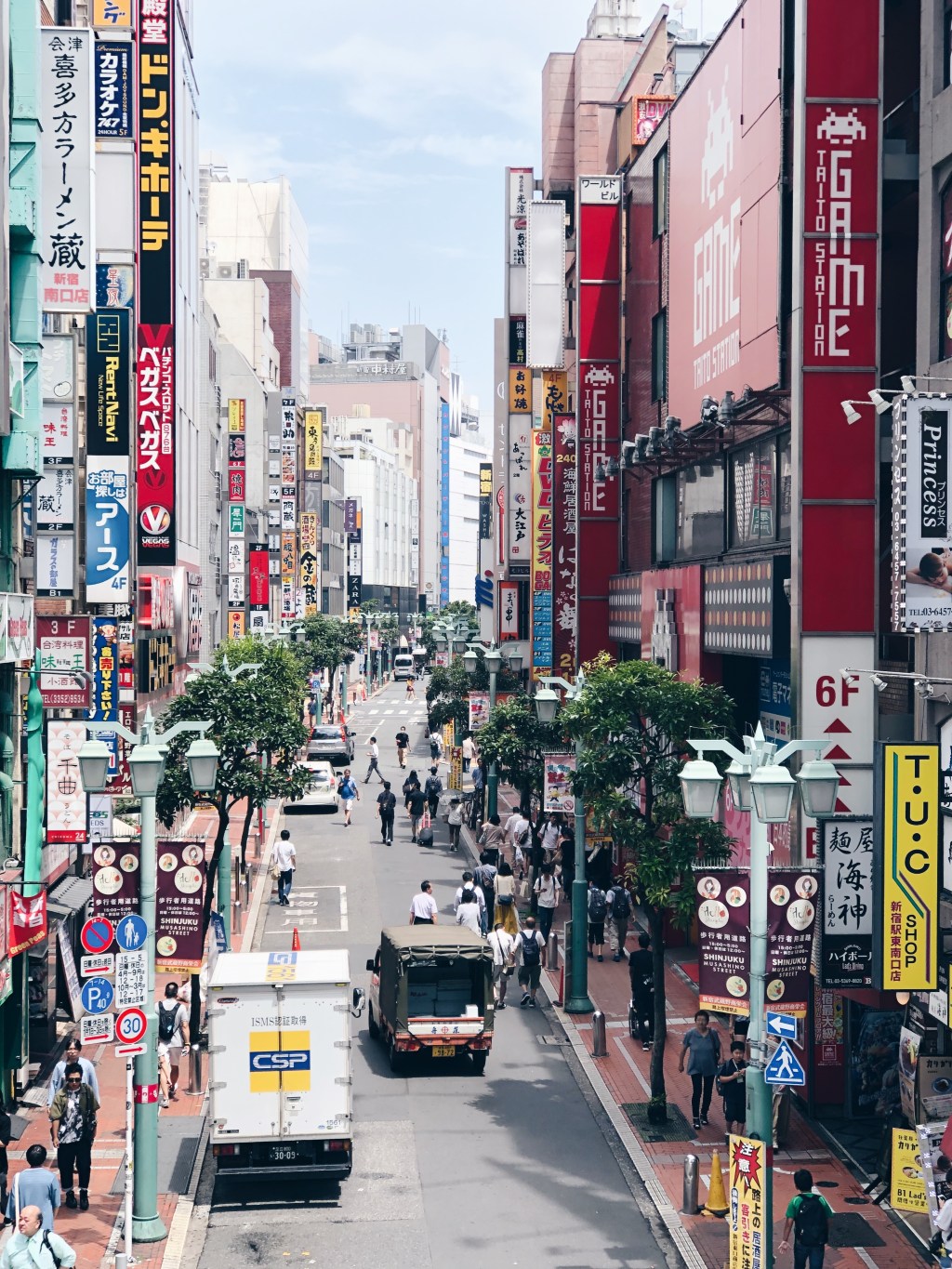
My first trip to Asia: twenty-five days, six countries, and thirteen cities, the majority of which belonged to Japan. Clean streets, lots of easy to follow signage and impressive transit systems. Why didn’t I think to come here earlier?
Often times, Asia gets lumped into the umbrella idea of the Global South. Westerners use their far removed opinions as a deterrent, a fear factor of sorts, to stay as far away from Southeast Asia as they can. There are talks of a poorer quality of life, of diarrhea scares, of typhoon epidemics, of dirty streets, of life-threatening traffic, and of a lack of AC; all the things that scare away impressionable North Americans.
Cities are complex systems, and in each area of the world, their definition of high functioning relies heavily on the local factors in each space at each given time. Granted that I visited more developed cities (Singapore, Japan, and Korea being strong powerhouses in Asia’s economy), Asia leaves me with the impression that it is, in many ways, more high functioning than North American cities, and most definitely more high functioning than European cities, many of which I’ve been able to see first hand. Naturally, throughout my entire time in Asia, my thoughts ran wild with comparisons of the various other cities I’ve seen throughout my studies and travels abroad, and I was prepared to be nothing but a tough critic. A tough critic that was in for a pleasant surprise, at that.
Is it really possible to learn anything by comparing urbanization in different countries, or is the range of information necessary for a meaningful comparison simply too large? This was the central theme of my entire trip, both while doing my own travels and while in Tokyo with the Masters and Ph.D. students from the University of Tsukuba and Ruhr-Universität Bochum.
I have a theory. Japanese cities (and a majority of other Asian cities) are a front runner, bound to surpass North American cities on a global scale because of how late they’ve entered the development race. They are like the younger, smarter sibling that has everything set up so nicely for them its smooth sailing till the end. Developing countries get to learn from the mistakes their older brothers, the OG powerhouses, made, all while wagging their fingers in our faces as they climb to the top as mom’s favourite.
Take a look at Europe, for example. It boasts some of the oldest cities in the world, but as the old saying goes, it’s hard to teach an old dog new tricks. How, then, does this explain their high walkability score, integrated transit system, the introduction of smaller sub-centres, and lack of mixed-use development? Day 2’s focus on the Sumida Ward really sets itself up for easy comparison, as disaster prevention seemed to be a central planning theme for most of the week. With old infrastructure comes a newfound development challenge, a planning problem that does not affect a majority of Toronto’s neighbourhoods. We do not have a significant amount of wooden houses, nor are earthquakes a pressing point of concern for our day to day life. Like the central question boasts, although there are many points that can be used for a cross-comparison city to city, each city is still unique. My take is that we can still learn a thing or two about Kiyojima and Hikifune’s disaster prevention methods, but instead we can use it for another more pressing community issue that Toronto faces – gun violence. Yes, Toronto has Neighbourhood Watch programs, but the same level of community engagement is not there. What if city planners created toolkits similar to the ones used in the event of an earthquake, but equipped it with the necessary items for an event that would constitute an emergency in Toronto’s landscape, even if it’s not necessarily crime-related. Just like it mobilizes the communities in Japan to meet in a common space, Toronto could also do the same and train locals to prepare to fend for themselves and their communities. This focus on social programming benefits both the community and the people and will cost the government less in the long run if the people are prepared to be there for one another.
Like the question suggests, there is a range of information necessary for a clean and fair comparison. This comparison is on a more even playing field with Tokyo and Toronto. Of all the presentations we had in Tokyo, there were a number of cities that compared quite seamlessly to those in Toronto, my observation is that both cities spinballed the majority of their recent intensification post-industrialization, WWII and automobile development. Day 1 we spoke about Takashimadaira, which in many ways, speaks to the CMHC’s affordable housing model and Canada’s first-ever National Housing Strategy that was implemented this year by the Liberal Party of Canada (currently in office) that has been brought forward. The issue of the ageing population in Tokyo, let alone Japan, is also becoming a growing issue in Toronto, as championed by public health city planners. Takashimadaira danchi (public condominium), which was opened in 1972 with a majority of hopeful young couples, has now transitioned into a majority 65+ living complex and is easily comparable to different suburbs (or sub-centres as referred to in the course themes) in the GTA where retirement communities have become prominent. London, ON and Hamilton, ON, which is just outside the GTA is widely considered to house one of the largest growing old age populations in and around Toronto. The booming of these sub-centres is becoming a widely pushed practice in Tokyo’s and Toronto’s planning as it allows for the disbursement of the population and intensification in the city’s core. Yokohama and Kashiwa are great examples of this, just like Scarborough, Markham and Mississauga are excellent examples of thriving sub-centres outside of the downtown core. Yokohama, in particular, is an excellent example of the post-war redevelopment, where the city was built from the bottom up after being destroyed by US air raid. Much like Singapore, the British influences are still very prevalent there, a prime example being The Full Monty British Pub & Cider House, a British pub that is still operating in a Japanese city. Yokohama, much like Hamilton, has a lot to offer for a city that is not too far outside of the core. Both are currently still developing (Yokohama’s Seaside Area Regeneration Plan and Hamilton’s 2016-2025 Strategic Plan) and both also boast a waterfront that offers significant development potential.
To touch on the high-density, mixed-use, walkable urban centres as a common prescription for fixing the ills of automobile-dependent cities in North America, there are quite a few things we can learn from such areas in Japan. I will start this off with a fact that is both mind-boggling and game-changing. The obesity rate in Japan is 3.6%, whereas, in the United States, it is 32% (Senauer & Masahiko, 2006). That translates to something like 10x more than our Japanese counterparts, which is absolutely ridiculous. I attribute it to the high walkability score in Japan and the easy access to public transit, among other things like their lack of fast-food culture and their overall ethnic food being generally healthier. The Japanese government does not invest in making their people sick, which is exactly why they boast the highest life expectancy in the world, where women are expected to live until 87 years old and males 81 years old. Interestingly enough, Singapore and South Korea (both countries that I also visited) are also higher on the list than Canada, which placed 12th in the world. For perspective, the United States came in at a whopping 31st, much lower than many of the other global powerhouses.
What I think is also noteworthy to mention is the practicality of Japanese city planning compared to that of Toronto’s. An easy example to draw upon is Kashiwa City (both Kashiwa Village and Kashiwa-no-ha Area), which is considered to be a smart city. The difference between their idea of a smart city and ours lies in practicality. Smart cities for the Japanese has nothing to do with fancy technologies and impressive futuristic design, as the Sidewalk Labs proposal suggested. Instead, it is simply about improving the quality of life. If you look at the buildings in Kashiwa City, many of them were not architecturally captivating by any means. In fact, many are comparable to the condo high rises in Tokyo or even the danchis in Takashimadaira. The difference was in the subtlety of the smart technologies, which focused on community support, environmental conservation, and regional contribution (such as watering flower beds, weeding, and the management of Town Health Centre). This is where the true meaning of machizukuri comes into play, as the city planning involves the community’s say, which is shown by the Kashiwa Village’s Jichikai Chokai (a neighbourhood association, consisting of residents living within the same area, in town or housing complex, where community activities are organized to keep a more cozy and comfortable living environment).
Drawing back to the central question, Day 4’s focus on the Otemachi also brought light to the inspiration that city planning, specifically in Tokyo, takes from around the world, which was mentioned in the opening presentation by Mr. Komai from the Mitsubishi Estate. He spoke about the inspiration that was taken from other major cities around the world, including New York’s Times Square that was used to model the Marunouchi Brick Square. Examples of this include the open space and underground pedestrian network (which is comparable to Toronto’s The PATH), the urban forest in Otemachi (modeled after Central Park to improve air quality), the water purification system for the Imperial Palace moats, and Nakadori Street ( which is comparable to our King Street Pilot) for improving walkability in the downtown core. As well, the overall CBD intensification of the Shibuya area, unlike Toronto’s, does not impose a maximum height limit and invites developers to build on the land and increase business at the core.
What is interesting are the future development plans for the area, which is contrary to the idea of developing the sub-centres, rather than the core. I attribute this primarily to the idea that private control is more so encouraged in Tokyo than in Toronto. Although the Japanese government has a very strong say when it comes to city planning, I strongly believe that the Japanese have managed to surpass Canada in their development process due to their emphasis on public-private partnerships, something that seems to have been a point of reluctance for the Canadian government, the Sidewalk Labs proposal being an excellent example to draw on. Torontonians have a fear of privatization and of a lack of government control, a lot of this attributed to issues concerning the disappearing middle class. The reason why this is not a similar point of contention for the Japanese is because of their heavy government subsidies, where there is ample, heavily-subsidized, affordable, vacant housing available. If each resident does not have concern for the basic necessities needed to survive, then it is understandable why there isn’t as much of a public consultation battle when private partnerships arise. The reason why their development is so effective is that there is more money and leeway in private control, and oftentimes projects are able to be rolled out at a much faster pace. The Tokyo Metro, which is privately owned and puts Toronto’s publicly owned TTC to shame, is an excellent example of effective private-public partnerships. This is just one small example of the many public-private partnerships highlighted during our time in Tokyo. The overall impression of Tokyo, let alone Japan, is one that is exemplary. It sets the bar very high for other cities to catch up, and in many departments at that. Cleanliness, lack of homeless people, safety, technology, transit, affordable housing, walkability, and quality of life are all areas where their groundwork policies set them apart from the rest. Developing countries are now giving the developed countries a run for their money, and it’s high time that the older sibling swallowed their pride and looked to their little brother for help. It might be the only way to win back mom’s approval.
* Please note that I am aware that Japan is a developed country, not a developing country. I have used it more so from the West’s metaphorical standpoint, where Japan (like China) is still considered to be fairly new to the group of developed powerhouses
 Lubna Alli
Leave a comment