

Walking through Palermo
The Mafia is very much alive and present. Today I felt afraid walking the streets of Palermo and talking about it openly during our tour with Stefano. It just felt like such a taboo subject that no matter how discreet we were in discussing it (which he reassured us we needn’t be), I felt we were risking our safety. Through the lens of Hofstede’s cultural dimensions, the Cosa Nostra seems to show high uncertainty avoidance, assertiveness and in-group collectivism, and its members all seem to have thick skin. Similar to the task-oriented leader, the Cosa Nostra means business. It puts up a façade of being people-oriented, offering the people of Sicily “protection” in exchange for pizzo, but in reality, its members are only in it for themselves. Their main goal is to obtain money, and they will use whatever means necessary to do so.
Structure, secrecy and family
The Cosa Nostra places a high value on structure, privacy and hard work. Secrecy is so central that it has its own name, omertà, the code of silence. Within the organization, directness is expected, and it is not to be mistaken for rudeness. The desire for orderliness spills over into business life, where surprises and humour are not welcome. One last value that is not to be overlooked is family and community; members depend heavily on their families for protection, safety, trust and comfort.
Why people join
These are the rewards that motivate leaders within the Mafia, and they explain why someone would want to take on a leadership role in the organization. Aside from monetary gain, members gain protection and acceptance. As was mentioned on the tour, once one person becomes a member of the Mafia, their entire family becomes affiliated with it in some way. They all work for each other and in each other’s favour. With this kind of pressure to fit in, especially among younger recruits, the tempting reward of feeling accepted is definitely a thing.
The oath
When it comes to building personal relationships among members, this is where the façade of the people-oriented leader comes into play. Relationships within the Mafia are built on trust. In the traditional initiation ritual, the new member’s finger is pricked and the blood is used to stain a holy image, often of a saint or the Virgin Mary. The image is then set alight in the initiate’s hands as they swear never to reveal the organization’s secrets. It is a striking choice of symbol. In a country with such deep Catholic roots, turning a sacred image into a loyalty oath shows just how far the organization’s claim on its members goes, above even their faith. It is one reason the personal relationships among members are so strong and are not taken lightly.
Measuring success through fear
Similarly, this is how a leader’s success is measured: by whether the task gets done. As the lecture notes titled “Breaking Ground On Cultural Dimensions: Hofstede” put it, the role of the leader is to influence followers to achieve a shared goal. Ultimately, the main goal of the Mafia is to obtain money, and it does this in a number of steps. One of the major steps is recruiting new members, usually those who appear vulnerable and easy to pressure. Another is intimidation. Success is measured by the number of shops that give in and pay the pizzo, pushed by explicit and implicit threats: funeral flowers or bullets left outside a door, graffiti, and physical harm.
It puts up a façade of being people-oriented, offering the people of Sicily “protection” in exchange for pizzo, but in reality, its members are only in it for themselves.
The other side of the story
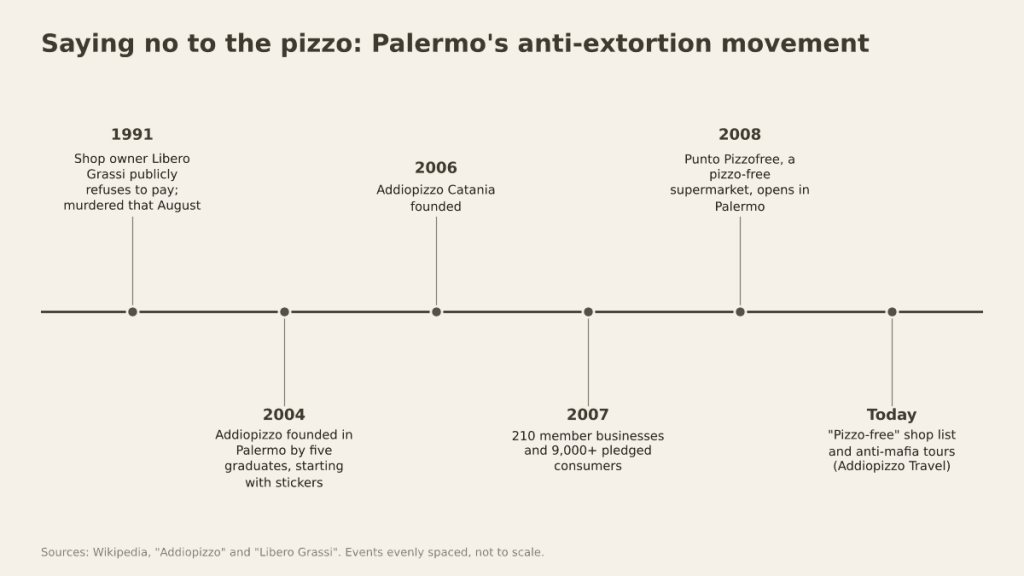
As someone so used to seeing leadership impact communities in a positive way, it is unfortunate to think that this is not the case with the Mafia. People sometimes argue that the Mafia fills gaps the state has left, but if that is true, it says more about the state’s absence than about the Mafia. Both of our tour guides were proudly anti-Mafia, and that perspective has stayed with me: Palermo is also a city of shop owners who refuse to pay and of consumers who choose pizzo-free businesses. All the more reason for me to go back to Sicily to learn more. That, and arancine!
Craving,
Lubna


Leave a Reply