
Reading: Zwick, A., & Spicer, Z. (2018). Good or bad? Ridesharing’s impact on Canadian cities.
Zwick and Spicer write a compelling and cohesive paper on the impacts of ridesharing on Canadian cities, specifically on the Uber vs. taxi debate. Ridesharing has experienced phenomenal growth in the last few years, which has impacted the taxi industry.
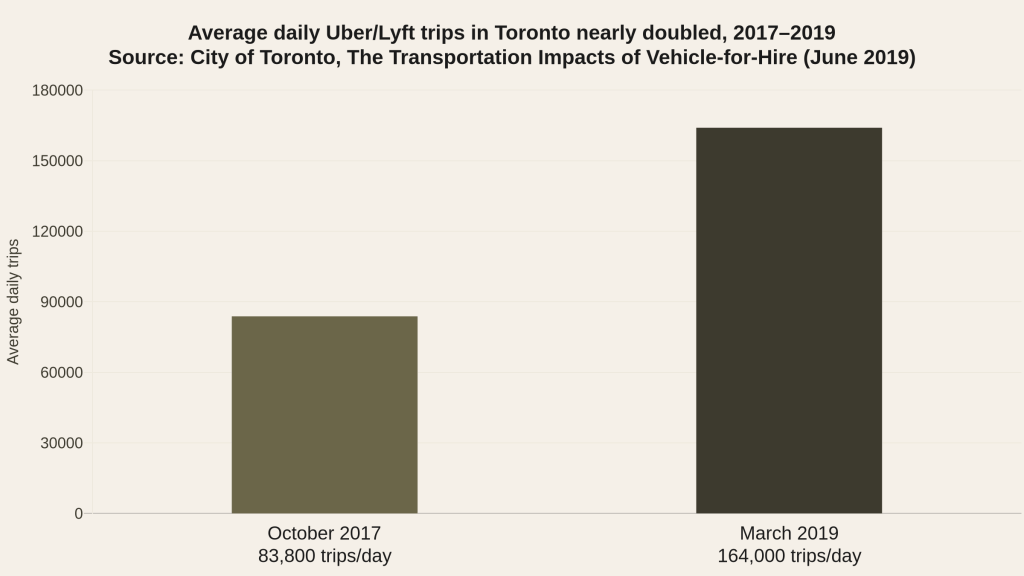
Two readings of the same disruption
Zwick argues that ridesharing has been detrimental to Canadian cities because it compromises safety standards, increases precarious labour, and intensifies congestion. Spicer, on the other hand, argues that ridesharing has been a positive for Canadian cities because it generates consumer surplus, creates new employment opportunities, and disrupts broken markets.
Both authors agree that Uber ought to be legalized and regulated, but ultimately they disagree on the appropriate standard. Zwick is more regimented in his approach, and believes that the regulatory bar for health, safety, and taxation should not be lowered to accommodate ridesharing. Spicer is willing to compromise, as he believes there is an opportunity for various stakeholders to collaborate to arrive at a consensus.

What would the framework actually look like?
Considering both conclusions, the implications for each would differ. Zwick is not entirely against ridesharing so long as it is within a government regulatory framework. What would this framework look like, and what policies would get pushed to the back burner for the sake of a more important pillar?
I would argue that Spicer’s conclusion also implies a regulatory framework of some sort, even if it is collaborative. This part of his thought process was not clarified enough. Yes, he believes in compromise and collaboration, but what will be the outcome as a result of this? Most likely a series of mandates derived from the discussions between the two actors.
Without a document in writing, the issue of lack of transparency in the platform sharing economy will continue to reappear as a major problem and cause for critique in this area.
Key takeaways
- Ridesharing trades consumer surplus and new work against safety, precarious labour, and congestion.
- Zwick and Spicer both want ridesharing legalized and regulated; they disagree on how high the bar should be.
- Even collaborative regulation needs written rules, or the platform economy’s transparency problem persists.
References
Zwick, A., & Spicer, Z. (2018). Good or bad? Ridesharing’s impact on Canadian cities. The Canadian Geographer / Le Géographe canadien, 62(4), 430–436. https://doi.org/10.1111/cag.12481
The platform economy series
- From the Sharing Economy to the Platform Economy (you are here)
- Engaging with the Platform Economy: Short-term Rental Housing
- Mobilization in Response to Big Tech and Short-term Rentals
- From the Platform Economy to City as a Platform: The Smart City
- Who Gets Left Out of the Platform City?


Leave a Reply