
Reading: Gurran, N., & Phibbs, P. (2017). When tourists move in: How should urban planners respond to Airbnb?
Gurran and Phibbs put together a paper that was well researched, written and formulated on a topic area as new to the game as Airbnb, which has been growing at a rate much faster than researchers and policymakers can mobilize to formulate substantial precedent research that informs best practice. The paper examines the different ways in which urban planners should respond to Airbnb’s implications for urban planning and policy.
Three questions for planners
The major question here is: how significant are these impacts?
- Do they generate neighbourhood impacts that require a new land use planning response?
- Do they create pressure on the permanent rental housing supply?
- Do they offer flexible income to help hosts make their own homes more affordable?
What the Sydney findings show
The findings, based in Sydney, Australia, were interesting but ultimately still surface level. They show that the bulk of Airbnb listings aggregate in areas of high tourist visitation but also extend beyond the inner core to residential areas already affected by tight rental demand. Local neighbours raised concerns about tourist behaviour, including noise, congestion, and safety.
The paper suggests that entire homes could be removed from the permanent rental supply, increasing pressure on rents, while the benefit to homeowners of offsetting their mortgage costs by listing their home on Airbnb is not significant.
The findings, based in Sydney, Australia, were interesting but ultimately still surface level.
The recommendation: monitor, then keep researching
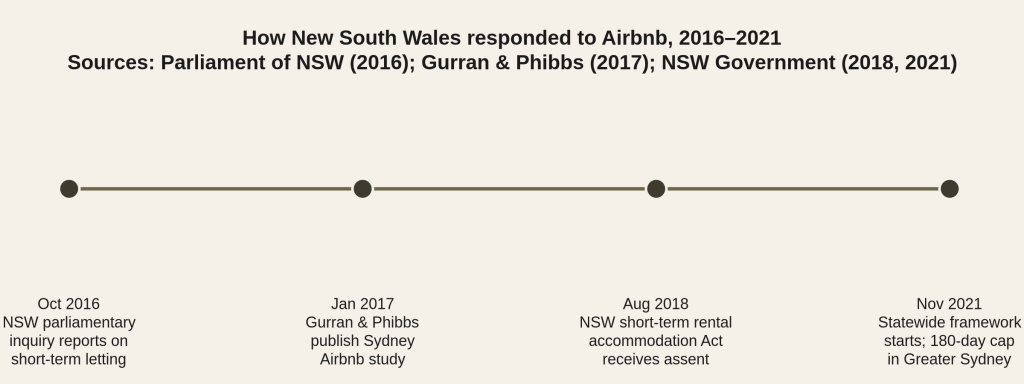
The final recommendation is to develop a cohesive policy framework that monitors the impact of Airbnb rentals on the availability and cost of lower-cost permanent rental accommodation, and to commit to ongoing research and analysis in order to fully understand the implications for local neighbourhoods and housing markets.
Key takeaways
- Airbnb listings cluster in tourist areas but spill into residential neighbourhoods with already tight rental markets.
- Whole-home listings can pull housing out of the permanent rental supply and push rents up.
- Planners need ongoing monitoring of Airbnb’s effect on lower-cost rentals, not one-off studies.
References
Gurran, N., & Phibbs, P. (2017). When tourists move in: How should urban planners respond to Airbnb? Journal of the American Planning Association, 83(1), 80–92. https://doi.org/10.1080/01944363.2016.1249011
The platform economy series
- From the Sharing Economy to the Platform Economy
- Engaging with the Platform Economy: Short-term Rental Housing (you are here)
- Mobilization in Response to Big Tech and Short-term Rentals
- From the Platform Economy to City as a Platform: The Smart City
- Who Gets Left Out of the Platform City?


Leave a Reply