
Reading: Wieditz, T. (2017). Squeezed Out: Airbnb’s Commercialization of Home-Sharing in Toronto. Policy report prepared for the Fairbnb.ca Coalition.
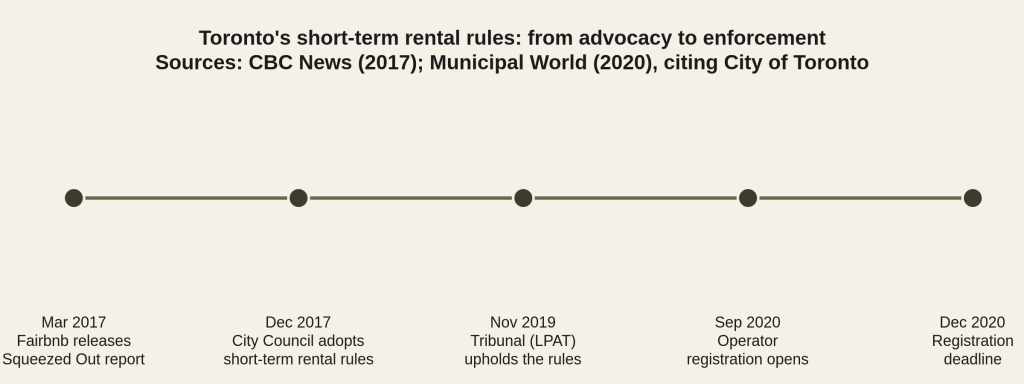
Thorben Wieditz’s policy report on fair rules for short-term rentals in the Toronto market, prepared for the Fairbnb.ca Coalition, provides extensive information on a fairly new case study, not just for Toronto but at a global-cities scale too. Because the case is so new, there is limited information on the effects of platform economy intervention on local ecosystems. The document provides an in-depth investigation of Toronto’s short-term rental market, and sheds light on the various issues associated with the proliferation of Airbnb and other short-term rental companies. Cited areas of concern include consumer protection, health and safety, housing availability and affordability, and the negative impacts of commercial ghost hotels.

“Little to do with so-called sharing”
The document continues to argue that the sharing economy has “little to do with so-called sharing,” as the majority of Airbnb Toronto’s revenue (63%) is generated by renting entire homes/apartments, rather than sharing a spare room. This inequality dynamic is further demonstrated by multi-listing hosts who own two or more listings, as they make up 16% of Airbnb’s hosts but control a disproportionately large share of Airbnb’s listings (38%).
By the numbers
63%
of Airbnb Toronto’s revenue came from entire homes/apartments.
16% → 38%
Multi-listing hosts were 16% of hosts but controlled 38% of listings.
Source: Wieditz (2017).
Loopholes and lost housing
To further drive home this issue of inequality, the policy loopholes and lack of auditor regulation become points of contention for those renting out condos that do not permit transient rentals shorter than thirty consecutive calendar days. The implication of this, among those listed above, is the loss of precious housing stock in the current housing crisis, where Torontonians are looking for a place to live.
The implication of this is the loss of precious housing stock in the current housing crisis, where Torontonians are looking for a place to live.
From recommendations to rules
The document concludes with model legislation recommendations from around the world that support real home-sharing and that home in on the trend of turning residential homes into hotels. As such, given the extensive work that Fairbnb has done, what are the prospects that these policy recommendations are enacted, and better yet, how receptive will policymakers and platform sharing actors be to these changes?
Key takeaways
- Most of Airbnb Toronto’s revenue came from entire homes, not shared rooms.
- A minority of multi-listing hosts controlled a disproportionate share of listings.
- Fairbnb’s model legislation targets ghost hotels while protecting genuine home-sharing.
References
Wieditz, T. (2017). Squeezed out: Airbnb’s commercialization of home-sharing in Toronto. Policy report prepared for the Fairbnb.ca Coalition, Toronto.
The platform economy series
- From the Sharing Economy to the Platform Economy
- Engaging with the Platform Economy: Short-term Rental Housing
- Mobilization in Response to Big Tech and Short-term Rentals (you are here)
- From the Platform Economy to City as a Platform: The Smart City
- Who Gets Left Out of the Platform City?


Leave a Reply