

The Draft Master Innovation and Development Plan, also known as the MIDP, is a 1,500+ page document that was released by Sidewalk Labs in June 2019. It is one that has brought about lots of tension amongst Torontonians, most of whom have concerns with the privatization and lack of public control in the city-building space. In the heat of the Sidewalk debate, I was lucky to be an active follower of the issue as part of smart city research I was conducting under Professor Andre Sorensen for GGRC54: Field Exchange in Tokyo, Japan. I would like to think I got a pretty decent perspective of the issue from all angles of the major actors, but with an issue as dense as this one, I am sure there will always be some component to follow. To give some context of my knowledge on the issue, I attempted to sift through the dense 1,500+ page MIDP, read through the 45-page RFP, read the Open Letter from the Waterfront Toronto Board Chair, and attended the information sessions. My read: the real question the plan raises is not about buildings, but about data.
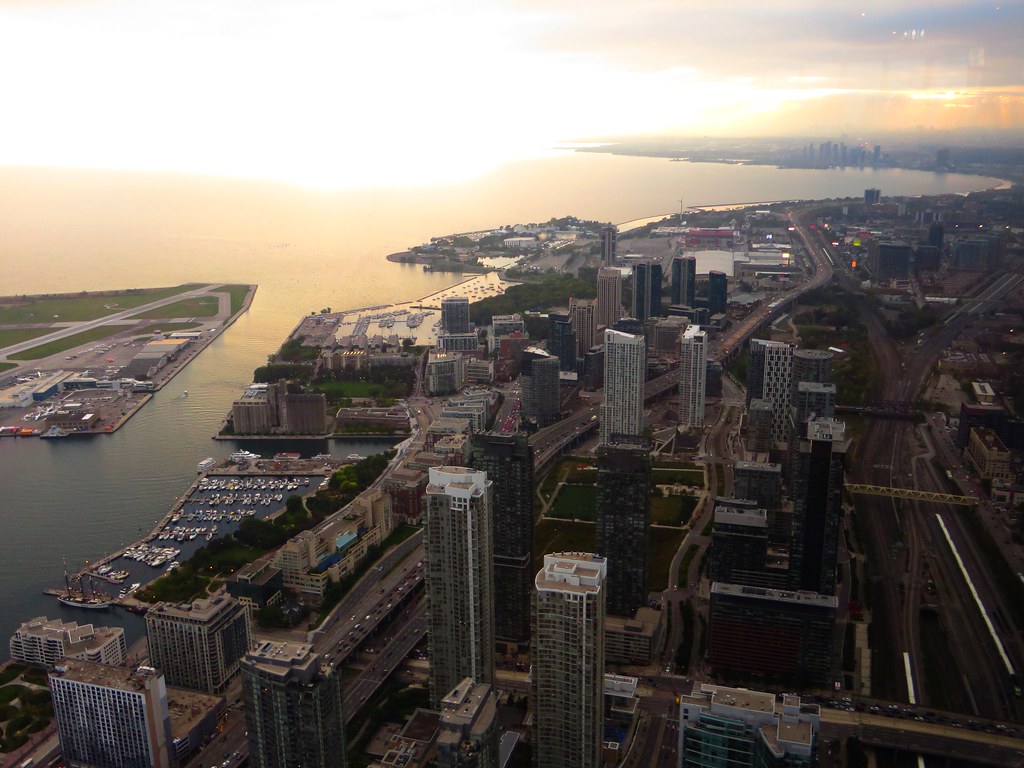
From a 12-acre site to a 190-acre vision
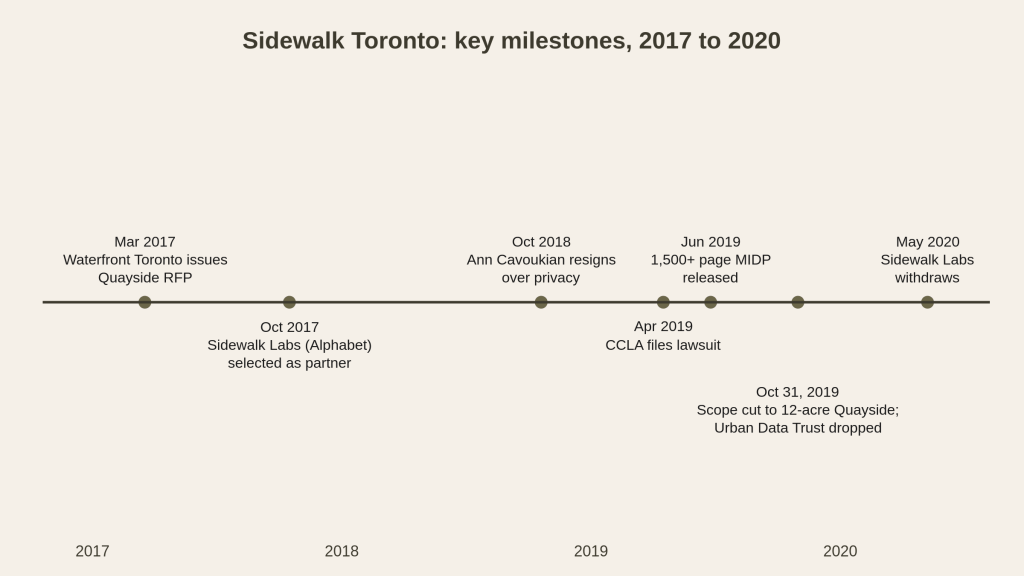
In March 2017, Waterfront Toronto, the tri-government agency revitalizing the waterfront, issued a request for proposals for an “Innovation and Funding Partner” for Quayside, a 12-acre parcel on the eastern waterfront. In October 2017, Sidewalk Labs, Alphabet’s urban innovation company, was selected (Sidewalk Toronto). The MIDP it released on June 24, 2019 went much further than that original site: four volumes and roughly 1,524 pages, including an optional “IDEA District” covering about 190 acres of the waterfront (StateScoop).
In Volume 2, The Urban Innovations, Chapter 3 (Buildings and Housing) and Chapter 5 (Digital Innovation) lay out some pretty attractive plans for developers and investors alike. For those in the political space, this raises more concerns around the land grab and the power grab, as they were categorized by Swerhun Facilitation when it led the public meeting for Block Sidewalk (an anti-Sidewalk Labs organization) in the summer.
For those in the political space, this raises more concerns around the land grab and the power grab.
The land grab is easy to see: a 12-acre site became a proposal more than fifteen times that size. The power grab is subtler, because it lives in the digital chapters.
Who controls data collected in public space?
Sidewalk Labs proposed a new category it called “urban data”: data collected in a physical space in the city, including public spaces such as streets and parks and private spaces accessible to the public, such as retail stores (Centre for Free Expression). That data would be overseen by an independent, non-profit “Urban Data Trust” that would review data collection, including by third parties (Future of Privacy Forum).
On paper, a trust sounds like a safeguard. In practice, a private company was defining a new class of data and designing the body that would govern it. In October 2018, Ann Cavoukian, Ontario’s former privacy commissioner, resigned as an adviser to Sidewalk Labs, citing concerns that her privacy framework was being overlooked (BNN Bloomberg). In April 2019, the Canadian Civil Liberties Association sued the three levels of government and Waterfront Toronto, arguing the project would collect personal data without meaningful informed consent, in violation of the Charter (BNN Bloomberg). Alongside it, the #BlockSidewalk campaign kept the pressure on in public.
Even Waterfront Toronto’s own Digital Strategy Advisory Panel was unconvinced. In its September 2019 preliminary commentary, it called the plan “frustratingly abstract,” noted that consent is still required at collection even if data is de-identified at the source, and recommended that data governance sit with Waterfront Toronto and governments rather than with Sidewalk Labs (BetaKit).
Trust, consent and who benefits
Consent works when you can say no. You can decline an app’s terms of service; you cannot decline a sidewalk. When sensors sit in streets and parks, consent becomes a collective decision, and it belongs with accountable public institutions, not the company that benefits from the data. Trust is earned through clear rules and independent oversight, not promises. As for who benefits: the value of a neighbourhood’s data, and the patents and products built on it, should flow back to the public that generated it.
October 31: Waterfront Toronto draws the line
On October 31, 2019, Waterfront Toronto’s board voted to move forward, but on very different terms. The project shrinks back to the 12-acre Quayside site. Sidewalk Labs drops the Urban Data Trust and the term “urban data,” agrees to store personal information in Canada and to follow existing and future privacy laws, and will partner with real estate developers rather than act as lead developer. Board Chair Stephen Diamond was clear that this is “not a done deal,” with a final decision due by March 31, 2020 (Waterfront Toronto; BetaKit).
To me, this is the right outcome for an unsatisfying reason: the data concerns were removed from the table, not answered. Until Toronto has a public framework for data collected in public space, the next proposal will raise the same questions.
Key takeaways
- The MIDP grew from a 12-acre site into a roughly 190-acre vision, which is why critics framed it as both a land grab and a power grab.
- Data collected in public space cannot rely on individual consent; it needs rules set and enforced by accountable public institutions.
- Waterfront Toronto’s October 31 deal removed the Urban Data Trust, but Toronto still needs its own framework for urban data governance.
Postscript
On May 7, 2020, Sidewalk Labs announced it was withdrawing from the Quayside project. CEO Dan Doctoroff cited the fact that “unprecedented economic uncertainty has set in around the world and in the Toronto real estate market,” and said the company could not make the project work “without sacrificing core parts of the plan we had developed” (Canadian Architect). The questions Quayside forced into the open, about who controls data gathered in shared spaces, under whose rules and with whose consent, are now the same questions at the heart of AI and data governance.
References
- BetaKit. (2019, September). Advisory panel publishes scathing commentary of Sidewalk Labs’ master proposal.
- BetaKit. (2019, October 31). Waterfront Toronto agrees to press forward on Sidewalk Labs Quayside project.
- BNN Bloomberg. (2018, October 22). Ontario’s former privacy commissioner resigns from Sidewalk Labs.
- BNN Bloomberg. (2019, April 16). Civil liberties group files lawsuit over Sidewalk Labs Quayside project.
- Canadian Architect. (2020, May). Sidewalk Labs pulls out of Toronto waterfront smart city project.
- Centre for Free Expression. (2019, May). Google’s “Urban Data” plan: Evading regulation while promoting the appearance of transparency.
- Future of Privacy Forum. (2019, July). Sidewalk Labs releases detailed plans for Quayside, including proposed privacy and data protection framework.
- StateScoop. (2019, June). Sidewalk Labs releases master plan for Quayside project in Toronto.
- Waterfront Toronto. (2019, September 10). Digital Strategy Advisory Panel: Preliminary commentary on the MIDP.
- Waterfront Toronto. (2019, October 31). Open letter from Waterfront Toronto Board Chair.
- Wikipedia. Sidewalk Toronto.


Leave a Reply