
Essay · April 2020
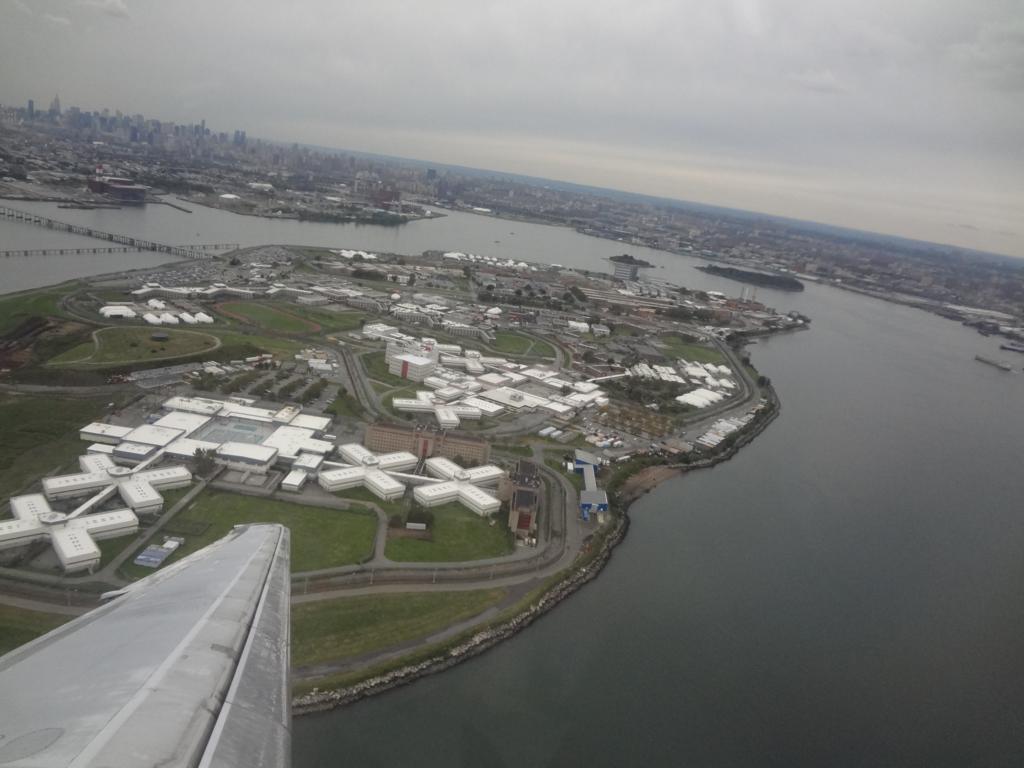
Located on 413 acres of city-owned waterfront property within sight of the Manhattan skyline, Rikers Island is a group of 10 separate jails with an average daily inmate population of approximately 11,000 and a median stay of around 13 days. This jail system is among the largest in the world (MacDonald et al., 2015). With capacity for 16,000 inmates, and approximately 85,000 people admitted and released annually (Wynn, 2012), the island serves as a literal penal colony.
Mass incarceration at Rikers Island is an urban social justice issue deeply rooted in the idea of the penal state. In this essay I offer a discussion of Rikers Island itself, in particular the capitalist interests built on the backs of poor, racialized people to feed a self-serving system. I then discuss in three sections how a) the penal state survives on a structure of neoliberalism that centers on racial capitalism, b) state regulation encourages a reciprocal relationship between the private corrections industry and politics, and c) a flawed penalization and penal policy system continues to perpetuate the same violence on Black and brown communities.
A city of its own
Established in 1932, yet unlisted on many New York subway maps, Rikers boasts a power plant, three high schools, a firehouse, a hospital, a courthouse, a tailor shop, and a bakery (Wynn, 2012). It is, in essence, its own functioning city.
Its facilities include the Rose M. Singer Center, named after a woman who served on the Board of Correction from its creation in 1954, which houses female inmates and includes a twenty-five-bed nursery for short-term detainees awaiting trial for under a year. There is also a facility opened in 1972 and named after Robert N. Davoren, the former Chief of Department and holder of the highest uniformed position in the New York City Department of Correction, which houses, in separate quarters, adolescent male detainees (ages 16 to 18) and adult male detainees in modular dormitories, sprung structures and cells.
There are a number of facilities for male detainees awaiting trial, the largest being the Anna M. Kross Center (AMKC), named after a Russian-American lawyer, judge and public official who was the Department of Correction’s (DOC) second female commissioner. The AMKC houses male detainees in 40 housing areas spread over 40 acres, including a Methadone Detoxification Unit and the DOC’s Mental Health Center, established in 1962. Also noteworthy are the Brooklyn House of Detention and the Eric M. Taylor Center (EMTC), home to more than a thousand combined detainees serving sentences of a year or less. The Eric M. Taylor Center, formerly known as the Correctional Institution for Men, houses both adult and juvenile male offenders, many of whom are used as a labour force to provide landscaping, maintenance, and industrial duties for Rikers Island.
The jail’s business-as-usual approach employs just as many uniformed officers as it has inmates, if not more, costing more than $100 million to staff the DOC’s headcount of 10,220 (Jorgensen, 2015). At Rikers it costs roughly $85,000 per year to house an inmate, which is about three times the national average to house a prisoner and eight times what New York City spends to educate a child in public school (Wynn, 2012). On medical costs alone, a study of Rikers Island “hot spotters” found that the most frequently incarcerated had chronic mental health and substance use problems and charges that were generally minor, at a costly incarceration toll of $129 million in custody and health costs, compared to the $38 million average (MacDonald et al., 2015).
Held without conviction
Despite its classification as a prison, Rikers Island operates like a county jail, as it holds short-term inmates and detainees from across New York City who are awaiting trial. An estimated 79% of these detainees are pretrial: they have been charged but not yet convicted of a crime (Shanahan, 2018). A large share are simply unable to afford bail, which averages a mere $500. Less than a quarter have been charged with a violent crime; most are in for drug or public order offences (Wynn, 2012).
The New York City DOC estimated that in the quarter from October to December 2016, Rikers saw more than 35,000 visitors (Shanahan, 2018). The barriers to visiting are rampant: the number of checkpoints and hours spent going through the process can take up a full day, before even factoring in cost, including rampant ticketing in the surrounding area. As Shanahan (2018) writes, “Upwards of five hours can pass between visitors crossing the Buono Bridge to Rikers to when they cross back to Queens.”
Rikers by the numbers
79%
of detainees are pretrial: charged, not convicted.
90%
are Black or Hispanic, versus 49% of New York City.
$85,000
per inmate per year: eight times the cost of educating a child in a city public school.
~75%
return to Rikers within a year.
Sources: Wynn (2012); Shanahan (2018).
Who benefits, and who doesn’t
Of the people involved at Rikers, the question of who benefits and who doesn’t is at the forefront of the discussion. On one side of the spectrum is a system spending $85,000 per inmate per year. On the other are the inmates, many of whom come from prison feeder communities: traditionally high-crime, high-poverty neighbourhoods that are disproportionately represented at Rikers. To draw on specific numbers, 90% are Black or Hispanic, groups that make up only 49% of New York City’s population. More astounding, 90% have no high school diploma or GED, 80% have a history of substance abuse, and about 75% return to Rikers within a year (Wynn, 2012).
These numbers are very real representations of the lives of Black and brown people subject to systems that target the marginalized and capitalize on opportunities to profit from them. At its very core, “Rikers Island is an extremely large, expensive correctional facility housing a disproportionate number of uneducated black and brown men with drug and mental health problems for nonviolent offenses, the majority of whom will return” (Wynn, 2012).
Racial capitalism
Mass incarceration at Rikers Island, and at many other penal colonies like it, has shown time and time again to be tied to money-driven efforts. This “new wave” of interest is masked under neoliberal policies that ultimately translate into privatization and targeted arrest quotas, both of which are linked to racial capitalism and the devaluing of Black and brown bodies. The neoliberal state has demonstrated the capacity to morph into a variety of institutional forms, to graft itself onto a range of different institutional settlements, and to absorb parallel and even contending narratives of restructuring and intervention in response to both internal contradictions and external pressures (Peck, 2003). As Pulido (2016) puts it, “racial capitalism captures the sense that existing capitalism exploits through culturally and socially constructed differences such as race, gender, region and nationality and is lived through those uneven formations.”
By privatizing public space, for example, we encourage higher levels of economic inequality and put more low-income people at a perpetually higher risk of street crime and violence. Public spaces such as parks are often the only respite for people who cannot afford accommodation. By encroaching on this space and putting private interest first, a prime example being the Occupy Wall Street encampment in Zuccotti Park (Kohn, 2013), the state not only dismisses the needs of its people but also uses the moment as an opportunity to profit from ticketing, arrests, and prison time. The same money-making logic shows up in senseless visitor parking ticketing at Rikers, which is not talked about enough.
Targeted arrest quotas have dominated much of the discussion in recent years, from the killing of Trayvon Martin to the rise of Black Lives Matter. After George Zimmerman’s acquittal and the police killing of Michael Brown, the U.S. Department of Justice’s 2015 investigation of the Ferguson Police Department found that revenue-driven enforcement was shaped by racial bias and racial profiling. If this is happening before arrest, why aren’t we talking about the fact that it continues afterwards, under state watch?
These are the lives of impressionable young men and women with parents, grandparents, aunts, uncles, loved ones. They are salvageable, but instead are wasted away to a system that cares about the profit rather than the person.
The United States now spends $215 billion a year to operate its criminal justice system, with spending on police, courts, and corrections rising some 660 percent in direct expenditures over 25 years (Wynn, 2012). More African American adults are under correctional control today than were enslaved in 1850, writes Michelle Alexander, author of The New Jim Crow: Mass Incarceration in the Age of Colorblindness. For Black men, the incarceration rate is 3,069 per 100,000 citizens; for white men it is 456 (Wynn, 2012).
The numbers are daunting and tell a story many turn a blind eye to. Why are prisons being held up on the backs of these bodies? What are the private interests? Better yet, who is benefiting? Racial capitalism is making money off the backs of poor, racialized people, and the people in prisons are so devalued that their lives have been subordinated to the goals of municipal fiscal solvency. Their devaluation is based on both their Blackness and their surplus status, where the two are mutually constituted (Pulido, 2016).
State regulation
The reality is that the state plays a major role in the high rates of mass incarceration in the United States, in particular through economic governance, citizenship relations, and social regulation. Economically, a growing number of people are on probation and parole, which encourages a system that has begun to feed on itself. It seems as though the state is criminalizing everything, and this cash grab is nothing new. Piggybacking off racial capitalism, the economic interests operate not only at a macro level but at a micro level, too. Governing and regulating these interests comes in the form of the war on drugs, a billion-dollar industry.
Why are prison systems growing despite lower crime rates? Wynn (2012) notes that between 1980 and 2010, probation and parole populations increased by roughly 75 percent, and that one in four adults (roughly 65 million people) has a criminal record, according to a 2011 study by the National Employment Law Project. This raises questions about what state regulation means for citizens’ relationships, in particular for the families of those incarcerated. According to a New York Department of Correction report for the last quarter of 2017, of the more than 50,000 visitors to the DOC system, only 94 were found to be carrying contraband (Shanahan, 2018). The gap between these numbers and the guilty-until-proven-innocent approach the system takes speaks volumes about how the regulated system continues to encourage zero-tolerance policing, ultimately endorsing high rates of incarceration under state watch.
Adding to the fire is social regulation, which shows itself most in racialized policing tactics. As cited in Shanahan (2018), Trujillo says that “the DOC has no control over the number of detainees and inmates admitted to Rikers, and its population figure is instead dependent on cops and courts, influenced by racialized practices such as aggressive street level ‘Broken Windows’ policing.” Racialized policing paired with ticketing quotas and the same prison feeder communities continues to create a system of state regulation that feeds on itself, thriving off the vulnerabilities of marginalized groups who are most exposed to poorly designed, state-regulated policies.
Penalization and penal policy
Building on state regulation, penal policy and penalization approaches produce mass incarceration and high recidivism rates, and create the need to redirect efforts into social program funding to undo the effects of poorly designed policies. Neil Smith’s idea of revanchist urbanism has played a recurring role in the development of penal policies at Rikers and beyond. He writes that “the scale of the urban is increasingly defined in terms of the geographical limits to daily labor migration”, and that once the social division of labour between production and reproduction becomes a spatial division, “the social and territorial organization of the social reproduction of labor—the provision and maintenance of a working-class population—comes to play a pivotal role in the determination of the urban scale” (Smith, 2002).
Translated to Rikers, the idea rings clear. Building jails of a scale to accommodate up to 16,000 inmates only makes room for more inmates and more staff, at the most basic level. Beyond this, what does it say about the intent of mass incarceration policies in the first place? Why is there such a heavy focus on the number of people expected to “break the law”, as opposed to restructuring the approach in other ways, be it through the legalization of marijuana, the retraining of police, or a redesign of jails and prisons with a focus on rehabilitation rather than punishment?
This preparation for mass incarceration targets ex-offenders and pushes those in authority to look for reasons to feed some of the highest recidivism rates in the country, where about 75% will return to Rikers within a year (Wynn, 2012). These are the constricting structures our policymakers are thinking up, and, more so, that we are voting into power. We need to shift our efforts to a social programs funding approach: one that addresses issues from the ground up, in the homes of families and in the neighbourhoods they grow up in.
Conclusion
In examining the effects of mass incarceration on Rikers Island, the presence of racial capitalism rings clear. Its intersectionality is undeniable, and it remains a consistent theme at every layer, from targeted ticketing at the neighbourhood level all the way up to private interest-based policymaking at the national level. At its very core, mass incarceration at Rikers Island is an urban social justice issue deeply rooted in the idea of the penal state, which profits off Black and brown bodies to further private interests. It survives on a structure of neoliberalism that centers on racial capitalism, state regulation that encourages a reciprocal relationship between the private corrections industry and politics, and a flawed penal policy system that continues to perpetuate the same violence on the same communities.
“Some lives matter more than others, some lives matter so much that they need to be protected at all costs, and some lives matter less, or not at all.”
Judith Butler, in conversation with George Yancy (2015)
Grappling with these systems means serious restructuring is needed to begin to reconcile the harm these targeted policies have caused to the lives of the incarcerated and their loved ones.
Key takeaways
- Most people held at Rikers have not been convicted of anything, and many are there because they cannot afford bail of around $500.
- Racial capitalism explains who ends up there: 90% of detainees are Black or Hispanic, drawn from the same prison feeder neighbourhoods.
- Breaking the cycle means funding social programs and rehabilitation, not building capacity for more incarceration.
Postscript: In October 2019, New York City Council voted to close the Rikers Island jails and replace them with smaller borough-based facilities. The legal deadline for closure is August 2027.
References
- Alexander, M. (2010). The New Jim Crow: Mass Incarceration in the Age of Colorblindness. The New Press.
- Jorgensen, J. (2015, January 22). Rikers Island will have more officers than inmates under proposed budget. Observer.
- Kohn, M. (2013). Privatization and protest: Occupy Wall Street, Occupy Toronto, and the occupation of public space in a democracy. Perspectives on Politics, 11(1), 99–110.
- MacDonald, R., Kaba, F., Rosner, Z., Vise, A., Weiss, D., Brittner, M., … & Venters, H. (2015). The Rikers Island hot spotters: Defining the needs of the most frequently incarcerated. American Journal of Public Health, 105(11), 2262–2268.
- Peck, J. (2003). Geography and public policy: Mapping the penal state. Progress in Human Geography, 27(2), 222–232.
- Pulido, L. (2016). Flint, environmental racism, and racial capitalism. Capitalism Nature Socialism, 27(3), 1–16.
- Shanahan, J. (2018). “Visiting Day” at Rikers Island. Qualitative Research in Psychology, 15(2–3), 352–366.
- Smith, N. (2002). New globalism, new urbanism: Gentrification as global urban strategy. Antipode, 34(3), 427–450.
- U.S. Department of Justice, Civil Rights Division. (2015). Investigation of the Ferguson Police Department.
- Wynn, J. R. (2012). The inside Rikers: The social impact of mass incarceration in the twenty-first century. Judges’ Journal, 51(4), 23–27.
- Yancy, G., & Butler, J. (2015, January 12). What’s wrong with ‘all lives matter’? The New York Times.
- Facility details: Correction Officers’ Benevolent Association (2019), Robert N. Davoren Center and Anna M. Kross Center pages; PrisonPro (2020), Rose M. Singer Center and Eric M. Taylor Center pages; Pazmino, G. (2019), “Two NYC jail facilities to close in 2020,” Spectrum News NY1.


Leave a Reply