
Group Analysis · December 2025
Co-authored with Shadi Afara, Sana Afraz, Michael Antenucci, and Prem Bapna.
Costco has spent four decades building one of the most coherent business models in retail: low margins, high volume, a membership fee that creates recurring revenue and switching costs, and a ruthless focus on cost leadership. It works. The numbers are extraordinary. But the company is approaching an inflection point — one where the digital restraint that once protected its model is becoming a strategic liability.
The Model That Built the Moat
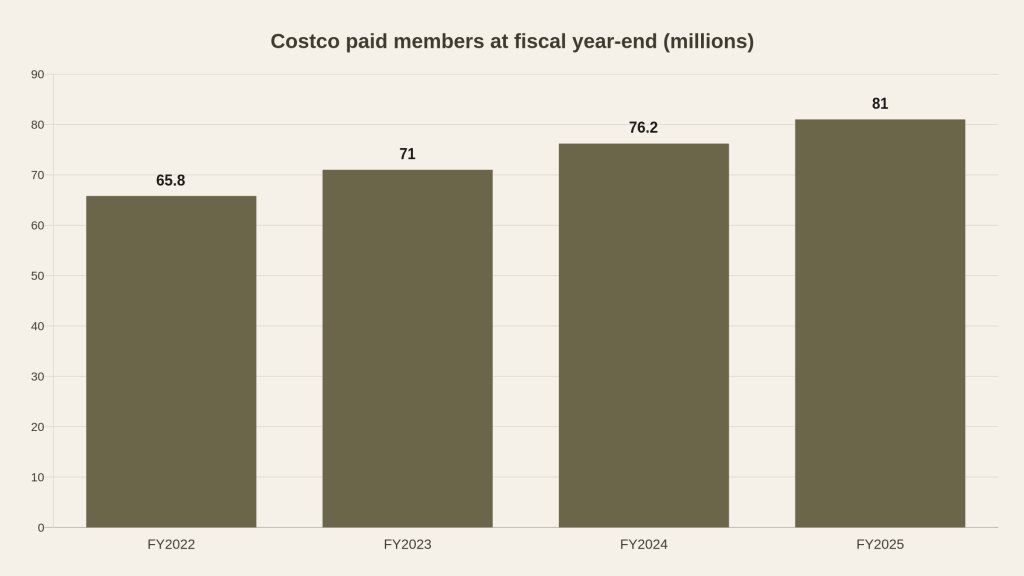
Since 1983, Costco’s strategy has been remarkably consistent. A limited SKU approach increases buying power and supplier leverage. Membership fees create a recurring, loyalty-based revenue stream with a 90.5% global renewal rate and 137 million cardholders (FY2024 10-K). Kirkland Signature — the private label that grew from early cost-control instinct into a trust-based brand — enables cost and quality control within a tightly aligned activity system. An employee-centric culture with high wages and strong benefits drives retention at 93%, ensuring consistent service and operational excellence.
These aren’t just operational strengths. In VRIO terms, the membership model, employee culture, and Kirkland brand each satisfy the conditions for sustained competitive advantage: valuable, rare, inimitable, and organizationally supported. Costco’s supply chain efficiency and real estate portfolio are strong, but imitable. The three anchors are not.
The Digital Gap
Costco’s FY2024 10-K shows e-commerce at roughly 7% of net sales, with digitally originated sales at around 9%. The business remains structurally store-centric, with digital framed as supplementary rather than a primary growth engine. This is coherent with Costco’s low-cost DNA. It is also becoming more strategically costly.
The competitor evidence is concrete. Sam’s Club has made technology a category differentiator, not an add-on. Scan & Go adoption is up 50% over three years, with roughly one in three Sam’s members now using it regularly and a Net Promoter Score above 90. The 2025 ACSI retail study reports Sam’s Club customer satisfaction rising to 85, overtaking Costco at 82 — attributing the gains to reduced checkout friction and technology-enabled convenience. BJ’s shows a similar trajectory, with digitally enabled comps up in the mid-30% range and more than 90% of digital orders fulfilled through clubs using BOPIS, curbside, same-day delivery, and app-based checkout.
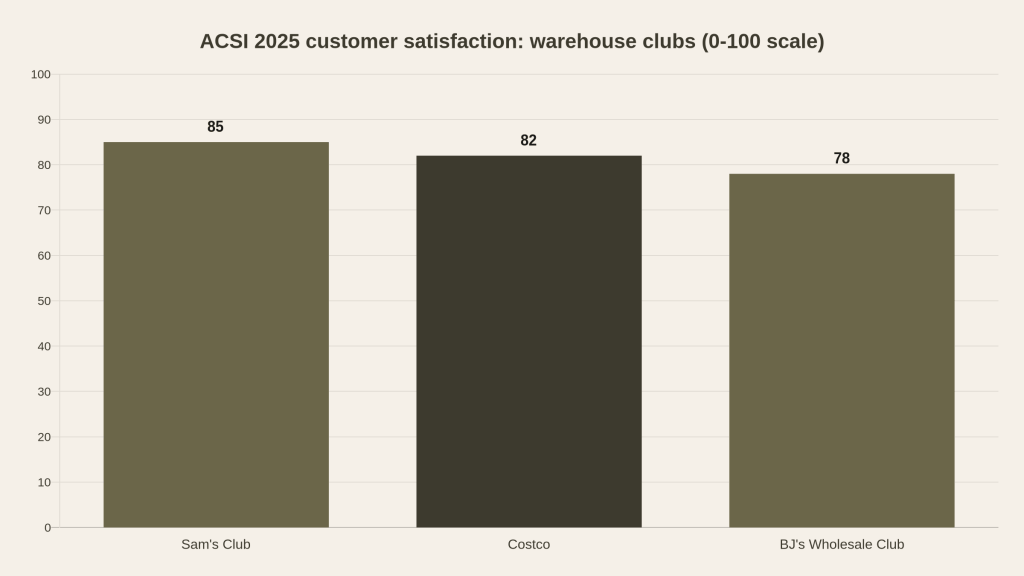
Against these benchmarks, Costco’s continued lack of scaled curbside pickup and slower rollout of in-club app convenience look less like prudent simplicity and more like a widening experience gap. The strategic threat is that “value” in warehouse retail is being redefined by rivals: not only lower prices, but lower effort. If Costco keeps digital in a permanently supporting role, it risks losing incremental trips and share of wallet to peers whose app-centric experience is becoming the category baseline.
“Value” in warehouse retail is being redefined by rivals: not only lower prices, but lower effort.
The Recommendation
Costco doesn’t need to become Amazon. It needs to selectively close the convenience gap without abandoning what makes it Costco.
A practical path: expand owned in-club digital tools (Scan & Go) across high-traffic warehouses, and pilot curbside pickup in a narrow set of dense, younger-skewing metro markets where the convenience payoff is highest. This phased approach preserves Costco’s low-cost logic while reducing the perception — and growing reality — of technological lag.
The ESG dimension is equally important and equally underdeveloped. Costco’s emissions transparency and supplier accountability trail industry leaders. As regulatory expectations accelerate globally, digital traceability and supply-chain data governance are no longer optional — they are baseline requirements for a company of this scale.
Costco’s historical digital restraint was once a coherent cost-preserving trade-off. It has become a strategic constraint. The model that built the moat is strong enough to evolve. The question is whether the organization will choose to let it.
Key takeaways
- Costco’s membership model, employee culture, and Kirkland Signature brand are its hard-to-imitate sources of advantage.
- Rivals like Sam’s Club and BJ’s are redefining warehouse “value” around lower effort, and Sam’s has overtaken Costco on customer satisfaction.
- Costco should selectively close the convenience gap — scale Scan & Go, pilot curbside in dense metros — and strengthen ESG and supply-chain data governance.
References
- American Customer Satisfaction Index. (2025, January 28). ACSI Retail and Consumer Shipping Study 2024–2025.
- Costco Wholesale Corporation. (2024). Form 10-K for the fiscal year ended September 1, 2024.
- Costco Wholesale Corporation. (2025). Form 10-K for the fiscal year ended August 31, 2025.
- Sam’s Club. (2024, February 28). Leading where it matters most: Transforming the shopping experience. Walmart Inc.
Co-authored with Shadi Afara, Sana Afraz, Michael Antenucci, and Prem Bapna. December 2025.


Leave a Reply